On my journey from Delft to Design Museum Den Bosch, I surpassed a variety of Dutch Design landmarks. The 30 by 30-centimetre street tiles, the omni-present ‘capitole’ trashcan from Pruyser, and of course the blue and yellow trains designed by Dumbar. Would I encounter these again during this exhibit? Will I encounter the same objects in the museum, as I saw on my journey towards it?
This new exhibit focussing on design and the nation state, is the first time the museum dives into this domain and the Dutch context. Knowing the Design Museum Den Bosch and their exhibition repertoire on critical, political, and bold exhibitions this will be another grand venture.

Figure 1. Promotional poster Vorm & Vaderland, design by Lesley Moore, 2026.

To start, ‘Vorm & Vaderland’ as a title alone is perfectly chosen. It is an adaption on the historical slogan ‘voor volk en vaderland’ (‘For the people and the fatherland’). This slogan is intertwined with the weekly magazine of the NSB, otherwise known as the Dutch Nazi party during the second world war. Second to this, fatherland is a gendered term. After visiting the exhibit, it addresses the male undertones in the design practice of the nation state: echoing the FORM/female FOLLOWS FUNCTION/male critique of Judith Attfield1. Attfield’s critique refers to the tendency to attribute aspects of function towards men or manliness, while form refers to the practice of women giving form or even female form features.

Therefore, the title of the exhibition is not just a case of alliteration. It is a carefully constructed title, which layers the Nazi past and the design of their nationalist propaganda, onto the male tendencies in the subject at hand. Sadly, this carefully constructed title cannot be translated without losing the layers it encompasses. Therefore, we are about to enter the ‘Designing the nation state’ exhibit.

Entering the exhibition, curated by Tomas van den Heuvel, one is met with an intimate setting and a clear theoretical starting point. The exhibition starts by introducing the viewer to the relationship between design and the formation of a national identity. The overall exhibit is framed around six layers, where every layer in the exhibition design is emphasized through an accentuating colour, and distinct décor style. The six layers are (in order of appearance): Drawing the borders, Citizens and patriots, Design of the people, The legitimate state, States of the imagination, and Consuming the Fatherland. One follows a clear route through the exhibit, where every new chapter becomes bigger, brighter, and bolder in their object reflections. It is an exhibition on the cutting edge of today’s discourse serving fresh perspectives in the curation of objects. I will focus on the specific sections of Drawing the borders and The legitimate state. All sections can be explored online at https://designmuseum.nl/de-verdieping/vorm-en-vaderland/.

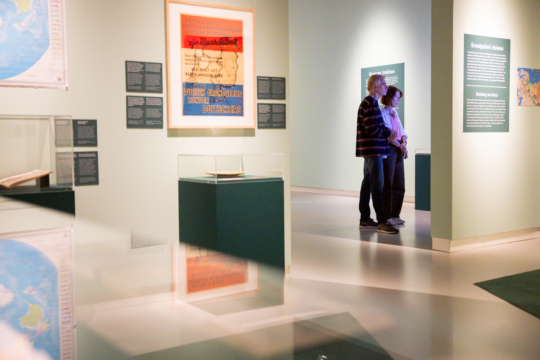
The first section ‘Drawing the borders’ focusses on the banality of borders. This is immediately apparent through the encounter with boundary stones, historic maps, and border walls. Drawing refers to the actual drawing of maps, to the imaginary construction of the state. We are shown the design of actual borders through the photographs of ‘Eight ways to build a border wall’ by Josh Haner: the eight prototypes of Trump’s ‘big beautiful border’ show, ‘designed’ visions of the USA as an impenetrable castle, or imagining Mexico as a prison next door. This absurd and even humoristic exposé of the border wall prototype echoes the banality of borders as an artefact. Furthermore, the exhibit also discusses ‘border technologies’ such as the passport. The think-piece ‘world-passport’ by Garry Davis makes a return, which I have already seen many times in similar exhibitions such as Phoenix Rotterdam and their exhibition on immigration. Much more interesting are the multitude of historic documents showing the predecessor to the contemporary design of the passport.

Figure 2. Garry Davis, World Passport, 1953.

One of the most interesting artefacts in this section is the Colourful Russian schoolbook map propagating annexed territory as ‘New-Russia’, juxtaposed to the 603,628 km² Black T-shirt from the ‘I stand with Ukraine’ product line. This exemplary curation and positioning of objects immediately shows where this exhibit shines the most: multi-modal objects positioned together to show that nationalism manifests in almost every discipline of design. It does so without losing or limiting political engagement and nuance in these geopolitical tensions. It is a well-formulated introduction to the concept of design and national identity for the general public, as well as a fresh and contemporary set of curated objects for professionals.

Figure 3. Drawing the borders section, photograph by Evita Copier.

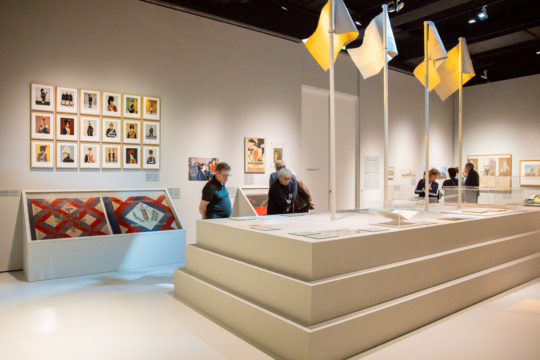
The third section ‘The legitimate state’ focuses on legitimization tactics through the design of objects. Centre stage is quite literally vexillology, the study of flags, positioned on a custom podium with flagpoles and flag prototypes at the center of the room. These design sketches of state flags are especially interesting. They give different options on what could have been, as well as insight into the other iconography a country wanted to make use of. Especially, the Israeli flag prototypes offer an insight into the active process of designing legitimacy as a state: Many different variants and iterations show us what could have been the flag, if it was ever chosen. Showing us the malleability of the flag as a medium for national identity. However, a small point of critique is the presentation. The size of these sketches are rather small, especially in contrast to the size of the stages they are installed upon.

An interesting aspect of the national identity discourse I had not thought about was the ‘diplomatic gift’: A category of objects that does not only represent the maker and country of origin, but also the recognition for the country of the receiver. Various gifts reflect the attitude of various countries towards other in their fight to legitimize and recognize their nation. From gifts intended for the representatives of the German Democratic Republic, to a golden Palestine brooch showing the historic map and flag etched into it.

Figure 4. Legitimizing the nation state section, photograph by Evita Copier.

The only discipline that I find missing in the whole exhibit is interior design. Architecture has played a major role in the design of national identity, which is acknowledged very well throughout the exhibition. Discussing the design of parliament buildings through building diagrams, floor plans, and models filling the space. From diagrams of the Hungarian parliament in Budapest, to a scale model showing an alternative concept for the Peace Palace in The Hague. Only clear reflections on the interior and their design are missing. Works such as parliament and their proposed interior typologies of parliaments by XML architects could have filled this void. A missed opportunity to create the complete gesamt-experience, to touch upon every design discipline.

At the end, we can even say our goodbyes to pictures of Rob Jetten and Péter Magyar. Reminding us, that this exhibit is not something history but actually important for today and tomorrow. As a final test at the end of the exhibit we are invited to create our own passport, serving as a test to see if we understood it all.

To conclude, the Vorm & Vaderland exhibit touches upon almost all design disciplines and their role in the creation of a national identity and material nation state. It is far more than yet another Dutch design canon filled with tiles, trashcans, and trains. Surpassing simple canonical overviews while critiquing them nonetheless. It is a well-balanced exhibition that introduces the topic for a broad audience: showcasing not only the end product, but the predecessors of certain border technologies which form our products to this day. Doing so with a certain nuance, flair, and build-up that is often hard to get right. For professionals it serves as a fresh curation of objects from every design discipline. It is an exhibition proven to be on the cutting edge of today’s discourse, at a time when the reflection on design and the nation state is needed the most.

References:

Attfield, Judy, and John A. Walker. “FORM/Female FOLLOWS FUNCTION/Male: Feminist Critiques of Design.” In Design History and the History of Design, 1st ed. Pluto Press, 1989. https://doi.org/10.2307/j.ctt18mvngc.15.

Fallan, Kjetil, and Grace Lees-Maffei. “Real Imagined Communities: National Narratives and the Globalization of Design History.” Design Issues 32, no. 1 (2016): 5–18. https://doi.org/10.1162/DESI_a_00360.

Author:

Nathan Douenburg MSc. MA.
Independent design researcher / vraagteken design
Delft, The Netherlands
Email: Nathan@vraagtekendesign.nl
Website: www.vraagtekendesign.nl

Al tien edities lang ga ik naar Oerol. Vanaf kinds af aan fiets ik heel het festivaleiland Terschelling over om de beeldende kunst in het landschap te zien staan. Zo hebben veel werken indruk op me gemaakt toen ik jong was, zoals Luke Jerram’s Museum of the Moon in de kerk van Midsland of Pi(n)k a place van Studio Ventura in het bos bij het duinmeertje van Hee. Vorig jaar nog maakte vergaan, de wandel- en rouwervaring van Elmo Vermijs, enorme indruk op mij. Vandaar dat ik er weer ben, en dit keer met pen en papier achterop mijn huurfiets. Nu ik dit jaar voor het eerst een hele week op Oerol verbleef, bood dit de uitgelezen kans om zowel de kunstroute als de expositie in de Tonnenloods te recenseren. Bij elkaar is dit een onderneming die meerdere dagen zou duren. Tevens is dit het eerste jaar waar op de online kaart de route is uitgetekend. Zo blijkt de meest optimale fietsroute 35,8 kilometer met 11 haltes voor de kunst. De recensie neemt dezelfde volgorde aan als mijn route over het eiland, verspreid over drie dagen. Belangrijk om te vermelden is het overkoepelende thema van de beeldende kunstroute. Namelijk de AMOC (Atlantic Meridional Overturning Circulation), een stroming over de hele wereld door alle wateren die een cruciale rol speelt in de werking van het klimaat. Kunstenaars werden uitgenodigd om zich te laten inspireren door deze golfstroom. Oerol zelf houdt het bij een summiere uitleg van hoogstens één alinea, voor een genuanceerdere uitleg verwijs ik je door naar deze video:


https://www.youtube.com/watch?v=dqLM65HfVEw

Spoiler: Enige kennis van het natuurfenomeen maakt geen enkel kunstwerk duidelijker noch daadwerkelijk interessant.

1 Marine Migrant – Marjolijn Boterenbrood

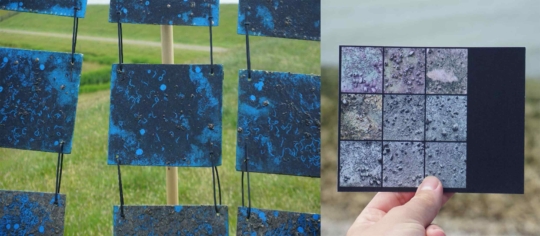
De eerste halte op de route aan de wadkant van het eiland, is de installatie Marine Migrants. Marjolijn Boterenbrood focust hier op het verborgen leven van kokerwormen, mossels, en zeepokken. Zeedieren die voor hun reizen geen kennis nodig hebben of beperkingen ervaren van visums en grenzen. We waren helaas te vroeg en een deel van de installatie bleek zich nog onder water te bevinden. “Dat hadden we op de website kunnen lezen” zei de vrijwilliger op de dijk.

Bij laagwater zijn drie bakken te vinden met de afdrukken van de eerdergenoemde dieren die blijven liggen bij de eb. Als enige vertaling buiten het water zijn er ansichtkaarten met de foto’s van de samples uit het water. Deze laten de bovenkant van installatie onder het wateroppervlak zien. Verder is er op de dijk nog een collectie aan fysieke afdrukken uit eerdere tests die hangen in de wind. Beide manifestaties zijn interessant, maar zonder enige verduidelijking blijft alleen de esthetische waarde hangen.


Het werk komt meer tot z’n recht in de online video’s waar we Boterenbrood aan het werk zien: daar blijkt dit werk eerder een fysieke vertaling van haar proces en liefde voor de dieren waar wij maar een negatief van zien. De videos hadden we op dat moment op de website kunnen zien. Helaas deelt het publiek deze admiratie niet en bleek deze halte een vruchtbare voedingsbodem voor 50-plussers met meerdere opmerkingen over wel menselijke-migranten.

2 De Streken – Marc van Vliet

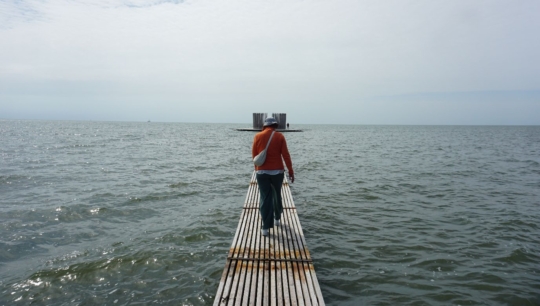
Voor de lezers die De Streken niet kennen, het is de Lourdesgrot van Oerol. Een waar bedevaartsoord voor zowel de nieuwe bezoeker als de veteraan. Ondanks dat je het al kent, blijf je toch terugkeren. De Streken is een houten bouwwerk in de Waddenzee. Het bouwwerk beweegt mee met de getijden en vertaalt zo eb en vloed. Over de jaren heen zien je ook hoe de materialen verkleuren, beschadigen, en verweren door de Waddenzee.

Alleen al het ietwat dunne houten looppad ernaartoe is een beleving op zichzelf. Nauwlettend om elkaar heen manoeuvreren om niet in de Waddenzee te vallen, of wachten totdat de kust vrij is om in één keer door te kunnen lopen. Hoewel het een van de beeldmerken is geworden van Oerol, doen foto’s het werk geen recht aan en moet de ruimtelijke ervaring zelf worden beleefd.

3 Raaklijn – SoAP, Rain Wu en Rita Hoofwijk

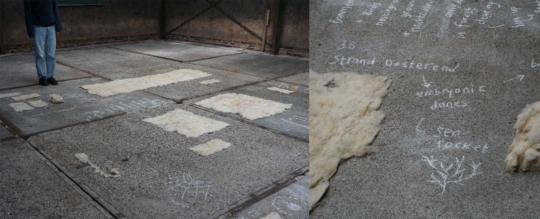
Voor het derde jaar op rij onderzoekt Oerol met Rita Hoofwijk de onzichtbare lijn tussen festival en Terschellingse natuur. Waar het in 2024 nog een audio-installatie verspreid over het eiland betrof, en in 2025 twee dansers die als een stepperoller over het eiland dansten, was het dit jaar nog wat wollig. Bij deze iteratie van Raaklijn dit jaar presenteert Rain Wu een architectonische reflectie naderhand haar onderzoek over het eiland. In een loods ligt een set aan experimenten van schapenwol in combinatie met aantekeningen eromheen gekrijt. De ruimte voelt leeg en onderbenut door het tweedimensionale karakter van het werk. De notities voelen als onderdeel van een procespresentatie of zelfs een tekening in een grot. Zo krijgt het werk een onleesbare oermens esthetiek, waarvan ik mij de hele tijd af vraag ‘wat maakt het nou architectuur’?


Er gebeurt visueel te weinig, en in inhoud en concept blijft het nogal oppervlakkig over wat nou die ‘raaklijn’ zou kunnen zijn. Extra informatie via een A4’tje naast het oorspronkelijke bordje maakt het ook niet concreter. Het werk voelt ongearticuleerd voor wat het had kunnen zijn. De indruk die het werk heeft achtergelaten is even vergankelijk als de materialen waarmee wordt gewerkt. Zonde, want het soortgelijke werk van Rain Wu zoals The Sea Rises and Totally Still zou uitermate geschikt zijn voor de context van Oerol en de waddenzee.

4 Turbine Songs – Dennis van Tilburg

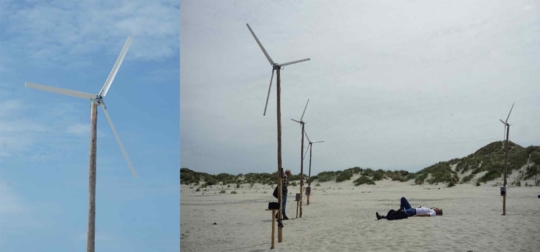
Op het strand van Oosterend, nog verder dan strandtent Heartbreak Hotel, bevindt zich Turbine Songs: een installatie zoals het op Oerol bedoeld is. Een collectie van zelfgemaakte kleine windturbines die samen stroom leveren aan de speakers aan hun voeten. Je neemt plaats in het zand terwijl je wordt meegevoerd door een soundscape met natuurgeluiden. Eerlijk toegegeven, toen ik aan kwam lopen had ik niet eens door dat de vogelgeluiden niet echt waren.

Het muzikale windpark biedt een immersieve zintuigelijke ervaring waar je meteen verdwaald in raakt. Daarbij is de enscenering in het landschap passend, alsof we naar een windmolenpark in de verte kijken. Ook de vormgeving van de molens zelf, op houten palen en met zichtbare kabels, brengt een eigen look met zich mee. Deze installatie is natuurlijk niet op te schalen naar de werkelijkheid, maar ondanks dat biedt het een interessant perspectief op daadwerkelijke windmolens, omgeving, en machines waar mensen daadwerkelijk geluidsoverlast van ervaren.

5 Moon Gazer – Thijs Ebbe Fokkens

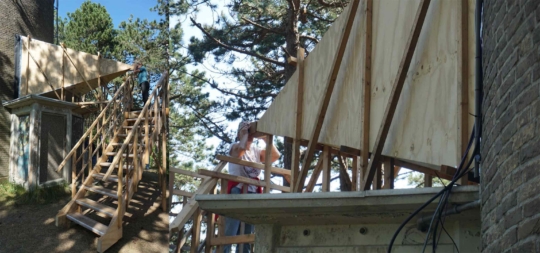
Rond het midden van de route, kon je via een zijpad en een weg door het bos uitkomen bij Moon Gazer van Thitjs Ebbe Fokkens. Een herontdekking van de maan, alsmede door een blik op de achterkant ervan. Via een houten stellage kijk je de oude watertoren in. Eerst moet deze beklommen worden, waarna je met één oog de houten telescoop in kan kijken. Het vergt wat oefening en focus maar daarna verschijnt daar toch ineens de achterkant van de maan.

Zelf vond ik de houten stellage naar boven, en het herinterpreteren van de oude watertoren het interessants. Hoe een interventie als deze zich naadloos aanmeet tot het bakstenenbouwwerk is bewonderingswaardig. De buitenaardse blik die van ons werd verwacht kostte ietwat veel inlevingsvermogen voor maar één afbeelding door een lens. Al met al een prima installatie die zich weet te verbinden aan oude bouwwerken in de openlucht in plaats van louter ‘natuur’.

6 MOC – Suzette Bousema

Halverwege de route, midden in het bos staat een glazen sculptuur. Als één van de duidelijkste koppelingen aan het thema (AMOC), brengt Suzette Bousema haar interpretatie van een stilgevallen golfstroom. De glazen golfstroom staat symbool voor de stilte. Hoe visualiseer je immers golfstromen die je niet ziet? Met materiaal waar we elke dag doorheen kijken. De glazen buizen hangen stil en sereen in de lucht op een metalen stellage. Per toeval lijkt het werk gerepliceerd door de houten stokjes met touwtjes in het gebied, die kwetsbare natuur zouden moeten beschermen.

Ondanks dat het glazen kunstwerk indrukwekkend is, neemt het in deze omgeving weinig ruimte in. Het werk zou beter tot z’n recht komen in een art-science expositie. Eén waar de schaal van de bomen niet het werk overschaduwen, en waar een monochrome achtergrond juist de details het werk in accentueren. Tijdens mij bezoek was er een vlieg in de installatie gevlogen, die zich ternauwernood door de hele installatie moest manoeuvreren. Een tekenend schouwspel.

7 The Wanderers – Valerie van Leersum

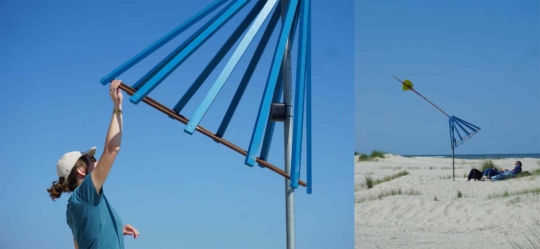
Terug op het strand, daar kom ik een soortgelijke luisterervaring tegen zoals Turbine Songs. The Wanderers van Valerie van Leersum is een kleurrijke illustratie in de duinen, een caranaleske vertolking van algen die zich ongezien door de wind laten meevoeren. Met een bijbehorende soundscape en objecten/sculpturen die je zelf mag bewegen creëert van Leersum een serene doch speelse omgeving.

Met The Wanderers vertolkt ze op gevoelige wijze een ecologisch fenomeen, als een choreografie van overgave. Het zelf bijsturen van de sculpturen, of de poging tot, onderstreept dit gevoel; ze laten zich namelijk niet vangen door iets anders dan de wind. Daarbij wil je door de soundscape zelf ook gaan liggen. Of dat door het fietsen komt of de charme van de installatie zullen we nooit weten.

8 Ecoshroom – S.O.I.L. – Ivan Henriques

Terug het bos in, daar staat een kubus op z’n kant. Ecoshroom – S.O.I.L. van Ivan Henriques onderzoekt door middel van deze installatie of mens, techniek en natuur samen kunnen leven. In de kubus komen uiteenlopende elementen samen: een algoritme, mos, planten, stalen frame, en verschillende vormen van sensoren en actuatoren. Al met al een recept om de installatie interactief te laten zijn. Deze installatie zou ook ‘interactief’ moeten zijn, aldus de omschrijving. Daar blijkt echter geen sprake van: interactie is immers een wisselwerking tussen mens en machine/kunst/object Is passief door een koptelefoon luisteren en ergens bij staan interactie?

Wel doet de kubus sporadisch wat de versafdeling van de Albert Heijn al een paar jaar doet, nevel sprayen over de natuurlijke elementen. Ik kan niet anders dan vaststellen dat ook het algoritme in de kubus niet verschilt van een kas in het Westland. Ik stond erbij en ik keek ernaar: net als met dergelijke ecologische vraagstukken en inzichten over natuurrampen.

9 Dienst Analoge Communicatie – Maaike Ebbinge / Eilandkinderen

Een jaarlijks terugkerend Oerol programmaonderdeel is Eilandkinderen, waarbij een kunstenaar wordt gekoppeld aan de kinderen van Terschelling. Dienst Analoge Communicatie van Maaike Ebbinge is een van de leukste en wonderlijkste edities van dit programma. Het begint al met een geel postkantoortje aan de rand van het bos, aan de buitenkant behangen met zelfgemaakte ansichtkaarten van de Eilandkinderen.

Bij aankomst word je verwelkomd door de postchef (Maaike Ebbinge zelf in kostuum) die je instrueert hoe je een kaartje moet versturen. Deze kaart leeft alleen tijdens Oerol en kan alleen daar worden verzonden en opgehaald. Ik ben nog nooit zo blij geweest met een product gemaakt door kinderhandjes; jammer genoeg mocht je er maar één per dag versturen naar iemand op het eiland. Het concept is niet alleen leuk en doeltreffend in zijn missie – de magie van post herontdekken -, maar ook in gedetailleerde uitwerking. Van de zelfontworpen postzegels tot de stempel, de kaartenrek en de brievenbus. Een kunstzinnig ontworpen festivalervaring, waarover ik naar huis zou schrijven.

10 My Little Tragedy – Nullshima Studio

De laatste stop op de kunstroute is de winnaar van de Symbio kunstprijs: een prijs voor kunst met impact en zeggingskracht in de transitie naar een duurzame wereld.

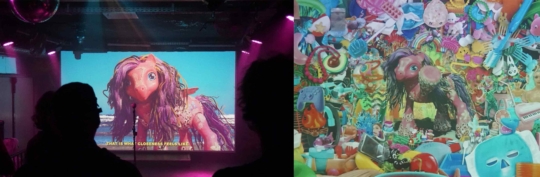
Ik moet toegeven, bij het zien van het eerste persbericht was ik sceptisch. Hoewel het verhaal sterk was, leek het beeldmateriaal A.I. gegenereerd. My Little Tragedy van Nullshima Studio neemt de nasleep van de ramp met containerschip MSC Zoë in 2019 – waarbij er 342 containers aan consumentenproducten zonken of aanspoelden in de Waddenzee – als uitgangspunt.


Bij aankomst betreed je een feestzaal in de dorpskern. Je ziet als eerst beelden uit de Waddenzee van duikers die speelgoed opvissen. Enter stage een dramatische geanimeerde pony die ons meevoert op een monoloog, terwijl die door de lucht vliegt. Eenmaal aangespoeld spreekt deze pony ons toe, en nodigt ons uit om mee te doen. Opeens start er daarna een kleurrijke plastic-rave. In alle kleuren overlaad het beeld ons met plastic producten, om op de leus ‘five grams a week’ mee te dansen en je over te geven aan de consumptiemaatschappij.

Allereerst ben ik zeer te spreken over ecologische kunst die breekt met dezelfde natuur-mos-mycelium esthetiek. Dat Nullshima Studio dit werk in een feestcafé in de dorpskern toont in plaats van in een bos, breekt enorm met wat we verwachten van dit genre. Daarbij is de muziek, lichtontwerp, en animatie tot in de puntjes uitgevoerd aardoor we ons wanen van de ramp tot de rave. Overtuigend is het zeker, maar bovenal blijft het deuntje net zoals het plastic in ons lijf hangen.

Daarover wel nog één ding, de stelling dat wij als mensen vijf gram plastic per week consumeren is wetenschappelijk onjuist. Het initiële onderzoek over microplastics uit 2022 at stelt dat we een pinpas per week eten is incorrect https://www.sciencedirect.com/science/article/pii/S2666911022000247). Toch heeft dit onderzoek voet tussen de deur van de zeitgeist weten te krijgen, zo ook bij Nullshima studio. De vraag is wel of het slecht is om een leugen te verspreiden die ons eventueel overtuigd minder te consumeren. Desalniettemin is dit werk een verfrissend narratief of op het gemiddelde ecologie/duurzaamheid/microplastic genre, en consumeer ik dit als zoete koek.

11 ’t Paradiis – Babette Rijkhoff & Heleen Haijtema (Tonnenloods)

Niet onderdeel van de kunstroute, wel benoemingswaardig. In de Tonnenloods was dit jaar ’t Paradiis van Babette Rijkhoff en Heleen Haijtema te vinden. Een drieschermige audiovisuele installatie die ons meeneemt door de drie dialecten op Terschelling. Terwijl we luisteren naar interviews, huisbezoeken, en gesprekken in de dialecten kijken we naar ontzettend gestileerde beelden van het eiland. Rijkhoff en Haijtema weten een balans te vinden tussen fantaseren over taal en articuleren. Een geweldig mooie samenkomst van verhaal en beeld, en de rol van dialect op een eiland als Terschelling.


35,8 kilometer verder en ik kan concluderen dat het een diverse route is met verschillende soorten en vormen aan werk. Waar The Wanderers spreekt tot de verbeelding in de duinen, en ik het spoor bijster ben bij Raaklijn, ben ik kritisch bij Ecoshroom – S.O.I.L, en lyrisch bij Dienst Analoge Communicatie. Een breed publiek aantrekken is de charme van een festival als Oerol, en dat reflecteert ook in de route. En ook in die route is het werk op elke locatie strak ge-ensceneert, en dat is niet mis voor een festival waar theater de boventoon voert.


Toch valt me op dat door het ecologische thema veel werk zich wetenschappelijk probeert te gronden. Het beoordelen ervan wordt daardoor een taak op zich. Het ecologische concept wordt een lat waaraan te meten. Hoe draagt dit dan bij? Reflecteert dit, of abstraheert het alleen? En helaas ook de vraag, kloppen deze feiten wel? De kunstroute van Oerol blijkt daardoor dit jaar eerder een kruistocht waar er meer wetenschapscommunicatie dan kunst plaatsvindt. Het is een moeilijke lijn om te bewandelen, ecologie is immers een vak apart. Ondanks mijn ietwat kritische blik, heb ik me laten meevaren over de route. Misschien niet op die ene golfstroom waarop de route was geïnspireerd, maar eerder op alle variëteit van wat er te beleven was op dit Terschellingse festival, want ook dat is Oerol.

Geen enkele regio heeft de Duitse industrialisatie zo sterk bepaald als het Ruhrgebied. De ontdekking van steenkool veranderde een verzameling dorpen in een van Europa’s belangrijkste industriële regio’s. Na de Tweede Wereldoorlog werd de vraag naar kolen, en daarmee arbeiders, steeds groter. In iets meer dan een eeuw groeide de bevolking van 300.000 inwoners in 1820 naar 5,7 miljoen in 1961.  

Velen kwamen uit Polen, later uit Italië, Turkije en Joegoslavië. Ze verrichtten zwaar en gevaarlijk werk, onder erbarmelijke omstandigheden. Tot ver in de twintigste eeuw werd steenkool grotendeels met spierkracht gewonnen en verplaatst. Ondergronds lagen explosies, instortingen en vallend gesteente voortdurend op de loer. Het is een geschiedenis die zich nog altijd laat aflezen in de steden van het Ruhrgebied, zo is te zien aan de wapperende Turkse vlaggen, de vele shisha lounges, kapperszaken en bakkerijen. De mijnen zijn inmiddels gesloten, de laatste sloot in 2018, maar de wijken en gemeenschappen die door deze migratiestromen ontstonden, bepalen nog altijd het gezicht van de regio. 

Tegen deze achtergrond vindt de zestiende editie van Manifesta plaats. Onder de titel This is not a church spreidt de Europese nomadische biënnale zich uit over twaalf kerken in vier Ruhrsteden (Duisburg, Essen, Gelsenkirchen en Bochum). De belangrijkste vraag die wordt opgeworpen is hoe om te gaan met al deze overbodig geworden religieuze gebouwen. Maar bovenal maakt Manifesta een geschiedenis invoelbaar die buiten Duitsland relatief onbekend is, die van de ‘gastarbeiders’ die de wederopbouw van het land mogelijk maakten. Hun verhalen, over hard werken, ontworteling, racisme, veerkracht en het opbouwen van nieuwe gemeenschappen, vormen de rode draad van deze biënnale.  

Voor dit essay bezocht ik in twee dagen acht locaties in Gelsenkirchen en Bochum. Ik combineerde mijn bezoek met het Mijnbouwmuseum. Een absolute aanrader voor wie meer historische context en verdieping zoekt. De uitstekende website van Manifesta is een waardevolle gids, met praktische suggesties om het maximale uit je bezoek te halen en soepel tussen de locaties te reizen. 

Dag 1 Gelsenkirchen  
Ons bezoek begint bij de St. Bonifatius Kirche, die voor de gelegenheid is omgedoopt tot de theetuin van Ferdane Satır (1944-1984). Op 26 augustus 1984 werden zij, haar vier kinderen, haar schoonzoon en haar kleinzoon van 52 dagen oud, vermoord tijdens een racistische aanslag in Duisburg. De rituelen en gebruiken uit de tuin, waarmee migranten zich letterlijk ‘aarden’, dienen als uitgangspunt voor de tijdelijke herbestemming van deze kerk. In de installatie van Bureau Baubotanik (2010), kan iedere bezoeker zijn eigen melange samenstellen in de geïmproviseerde theetuin en die, voorzien van een wens of boodschap, te drogen hangen aan het plafond van de vestibule.  

Tea, 2026 © Bureau Baubotanik. Foto Lisanne Bedaux (analoog)

St. Bonifatius Kirche. Foto Lisanne Bedaux (analoog)

De afzonderlijke werken in de kerk zijn op zichzelf al interessant, maar ontlenen hun grootste zeggingskracht aan de manier waarop moderator en curator Gürsoy Doğtaş ze met elkaar én met de geschiedenis van de buurt in verband brengt. Juist die samenhang maakt de presentatie zo aangrijpend. In de voormalige kerk ontvouwt zich een verhaal over arbeidsmigratie, geweld, identiteit en gemeenschapsvorming. Daarmee laat Manifesta zien waar de kracht van de biënnale schuilt: in curatie die vanzelfsprekend geworteld is in de lokale geschiedenis en de gemeenschappen die haar hebben gevormd.  

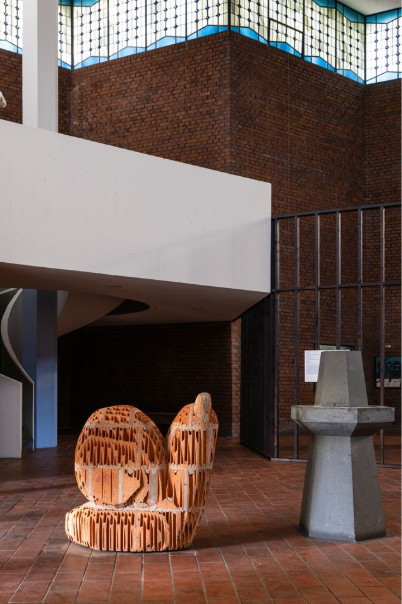
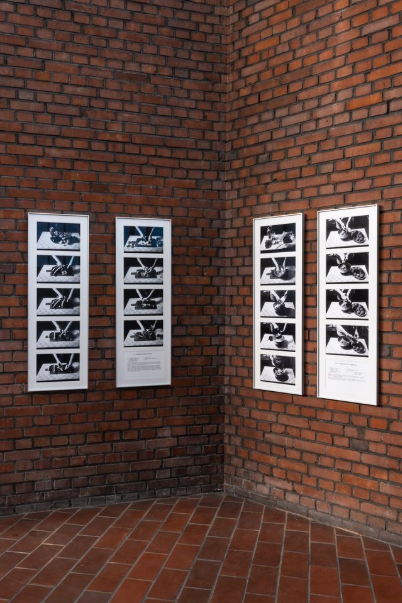
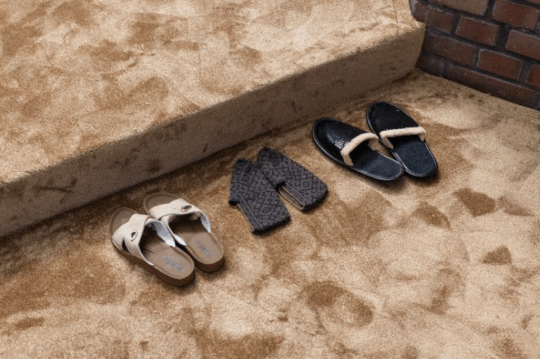
Judith Hopf (1969), draagt daaraan bij met een monumentale slak, gemaakt uit baksteen en cement.  De slak lijkt zich langzaam een weg te willen banen door het middenpad richting het hoofdaltaar. De open uitsparingen in de stenen en de associaties met sloomheid en slijmerigheid die het dier oproept, maken de sculptuur ondanks haar massieve materiaal broos en kwetsbaar. Nil Yalter (1938) toont een zwart-wit fotoserie waarin de seksistische namen van Turkse gerechten worden bevraagd en verbindt het alledaagse aan de positie van vrouwen binnen de migratiegeschiedenis. Op het altaar presenteert Merve Kaplan (1997) Yoldas, een installatie van verschillende interieurfragmenten en slippers. De roodbruine tegeltableaus, een vertrouwd element uit zowel de Turkse als Duitse huishoudens, roepen onmiddellijke associaties op met het huiselijke. Je ziet meteen een betegelde bruine woonkamer voor je, waar de slippers voor het binnengaan zijn uitgedaan. Geen van de werken van de 23 samengebrachte makers vertelt op zichzelf het grote verhaal, juist in de onderlinge dialoog en in relatie tot de plek ontstaat de magie.  

LESS (starting), 2026 © Judith Hopf. Foto © Manifesta 16 Ruhr / Ivan Erofeev 


La sexisme dans la cuisine turque ou la volupté culinaire d’un empire (Le PrêtreS’est Évanoui), 1978 © Nil Yalter. Foto © Manifesta 16 Ruhr / Ivan Erofeev 

Boven en onder: Yoldaş, 2025 © Merve Kaplan. Foto © Manifesta 16 Ruhr / Ivan Erofeev 

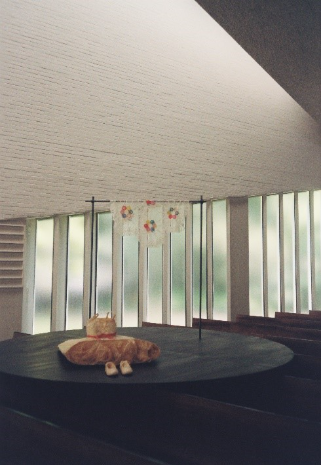
Een ander hoogtepunt in Gelsenkirchen is de Thomaskirche (1965). Alleen al de fantastische architectuur van deze naoorlogse modernistische kerk van de hand van Fred Janowski (1929-2019) en Albrecht Wittig (1928-1991) is een bezoek aan het Ruhrgebied waard. De architectuur past in de context van de jaren zestig, waarin veel protestantse kerken zochten naar nieuwe vormen van gemeenschap en samenkomst. De Thomaskirche was niet alleen een plek voor religieuze rituelen, maar moest ook een ontmoetingsruimte voor de groeiende wijk worden. In plaats van een klassiek schip met altaar op de centrale as ontwierpen Janowski en Wittig een compacte, sculpturale ruimte met sterke geometrische vormen. Een indrukwekkend decor voor een opstelling die volledig in het teken staat van vrouwenarbeid, textiel en immaterieel erfgoed met onder meer een draagbare minaret van PVC van Bettina Allamoda (1964), kantwerk van Fatma Ceylan (1963) en een jurk van epoxy met de titel ‘Child Bride’ van Azade Köker (1949). Weeftechnieken, kantklossen en textiel verwijzen naar generaties vrouwen wier vakmanschap economisch onmisbaar was, maar zelden dezelfde waardering kreeg als dat van mannen. 


Thomaskirche Gelsenkirchen. Foto © Manifesta 16 Ruhr / Dirk Rose


Child Bride, 2021 © Azade Köker en Untitled © Fatma Ceylan. Foto Lisanne Bedaux (analoog) 

We sluiten onze dag af met een bezoek aan de St. Anna (1970) en de St. Josef (1894 – 1896). Ook deze kerken hebben voor de duur van de biënnale een nieuwe bestemming gekregen. De eerste in de vorm van een muziekhal waar queer cultuur centraal staat. Interessant is de video-installatie van Cana Bilir-Meier Ein neues Wort (2025), waarin zij teruggrijpt op de schrijfwedstrijd in West-Duitsland uit 1970. Hierin werd gezocht naar een nieuw woord voor ‘gastarbeider’. Samen met een koor onderzocht Bilir-Meier de meer dan 30.000 inzendingen. Veel van de suggesties bleken ronduit racistisch en laten zien hoe diepgewortelde vooroordelen en vreemdelingenhaat verweven zijn met het publieke debat rond arbeidsmigratie. 
 
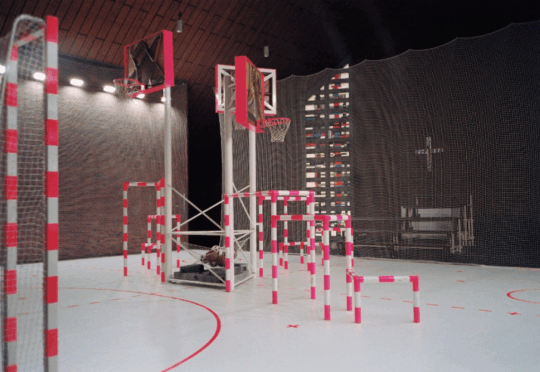
Bij het binnenstappen van de St. Josef waan je jezelf in een psychedelische AI rendering. In het schip van de kerk is een enorm blauw zijl opgeblazen. De begeleidende tekst suggereert dat hiermee een ‘contested space’ wordt gecreëerd. De installatie van Curro Claret (1968) is absoluut indrukwekkend, maar ik mis de relatie tot de geschiedenis van de regio, die de andere samenstellingen juist zo sterk maakt. Dat geldt ook voor onze eerste stop in Bochum, de St. Ludgerus. Kunstcollectief CaboSanRoque (2012) (Laia Torrents (1976) en Roger Aixut Sampietro (1975)) heeft hier een niet-competitief basketbalveld gecreëerd, waarin plezier en geluid centraal staan. Het is zeker vermakelijk om een potje basketbal te mogen spelen in een ruimte waar ballen normaliter niet zijn toegestaan, maar het mist de diepgang van de andere locaties.  

FailAgainFailBetter, 2026 © Cabosanroque Collective. Foto Lisanne Bedaux (analoog) 

Dag 2 Bochum 
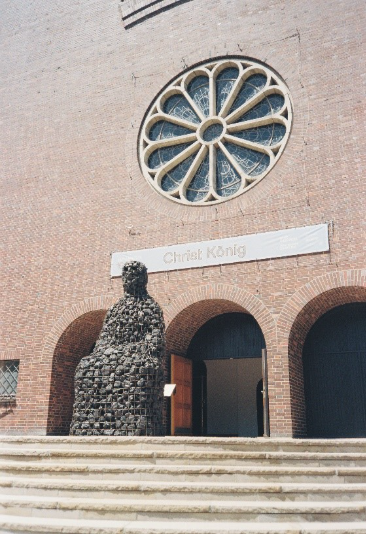
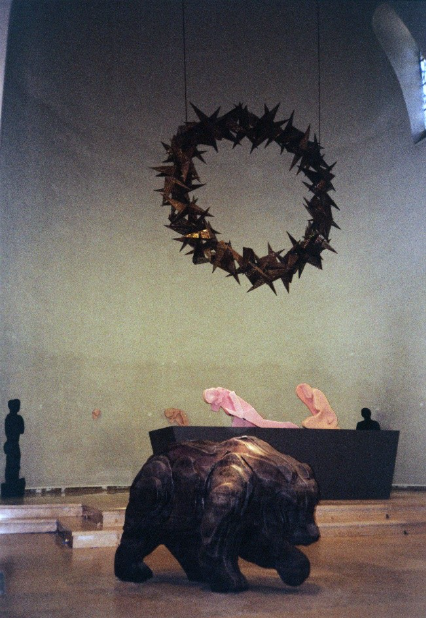
In 1930 werd het grootste mijnbouwmuseum ter wereld geopend, het Deutsche Bergbau-Museum Bochum. Gezien de thematiek van Manifesta is een bezoek zonder twijfel de moeite waard. Ieder uur worden door oud-mijnwerkers rondleidingen gegeven in de ondergrondse mijnschacht. Het is bijna onvoorstelbaar dat de laatste mijnen hier pas in 2018 sloten en dat op veel plekken in de wereld nog altijd op grote schaal op deze traditionele manier wordt gemijnd. We vervolgen onze reis met een bezoek aan Christ-König, waar we worden verwelkomd door een driemeterhoge Sedes Sapientiae van steenkool en staal van beeldhouwer Mirosław Bałka (1958).   

 
Foto boven: Madonna, 2026 © Mirosław Bałka. Foto onder Lisanne Bedaux (analoog), foto rechts © Manifesta 16 Ruhr / Ivan Erofeev 

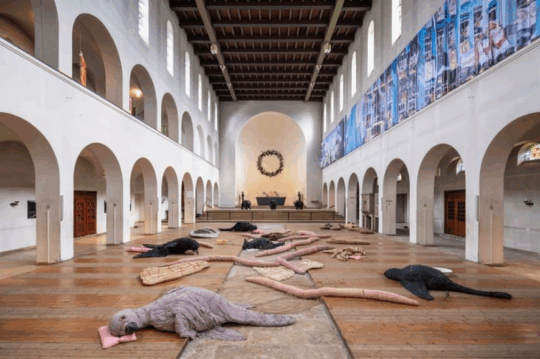
Je zou bijna denken dat het niet beter kan worden, totdat je de kerk binnengaat. De ruimte is getransformeerd tot een totaalcreatie waarin het onderscheid tussen de oorspronkelijke elementen van het gebouw en de kunstwerken volledig is vervaagd. Mijn hart maakt een sprongetje. Dit is precies de reden waarom ik zo graag naar Manifesta ga: je ervaart het gevoel dat wat zich om je heen afspeelt urgent is. Dat het gaat over de wereld van vandaag, over wat er nu gebeurt, en dat je daar niet omheen kunt. 

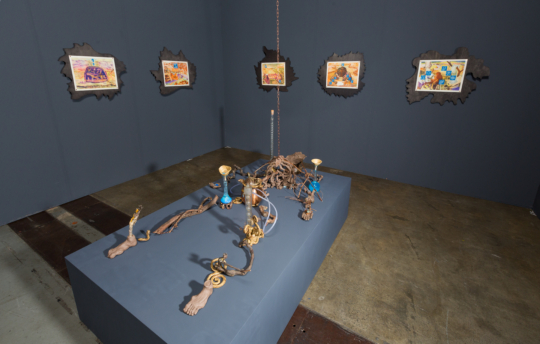
De totaalinstallatie overrompelt je, zonder dat je meteen kunt duiden waarom. De verwrongen en leeggelopen mensenhuiden in polyester van Mehtap Baydu (1972) en de reusachtige dode vogels van textiel op de grond die je mag knuffelen van Eva Koťátková (1982) roepen een gevoel op van verval en vernieling, maar ook van fundamentele vragen over de manier waarop we omgaan met mensen en dieren. Het voelt alsof we hier letterlijk én figuurlijk de kanarie in de kolenmijn aanschouwen, een beeld dat in het kader van een mijnwerkersstad niet toepasselijker had kunnen zijn. Voor mij persoonlijk vormt het altaar, met de diep ontroerende installatie waarin Malgorzata Mirga-Tas (1978) traditionele Roma-rekwisieten herinterpreteert, het absolute hoogtepunt. Hoewel het werk een geschiedenis vertelt die niet de mijne is, weet Mirga-Tas door de combinatie van materiaal en het gebruik van de ruimte een universeel gevoel van verbinding met de geschiedenis op te roepen.  

Foto boven When Animals Fall From the Sky, 2026 © Eva Koťátková (and children fromBochum and Prague). Foto onder © Manifesta 16 Ruhr / Ivan Erofeev onder Lisanne Bedaux (analoog)  

Ryćhino (Roma Bear), 2025 © Małgorzata Mirga-Tas. Foto Lisanne Bedaux (analoog)  

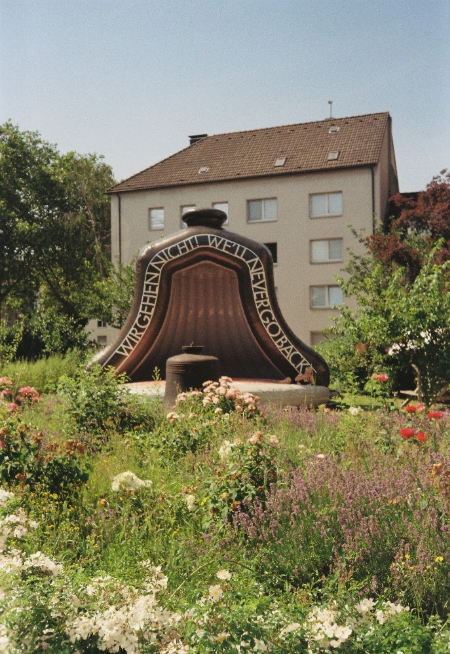
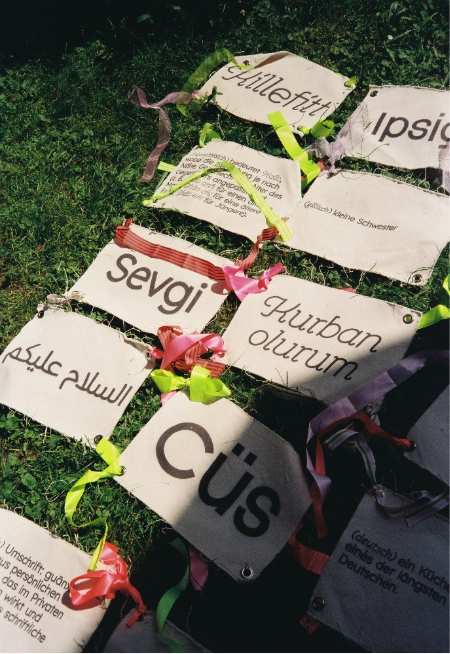
Ondanks de hitte besluiten we voor onze terugreis naar Nederland ook de twee laatste kerken in Bochum te bezoeken. Allereerst de Gethsemane-Kirche, een noodkerk van vlak na de oorlog, met onder meer een springkussen in de vorm van een kerkklok met de tekst ‘we’ll never go back’ en een interactief poëziewerk van de Pools-Duitse Julia Nitschke (1988). Onze laatste stop is de St. Anna, een monumentalere kerk uit 1929. Daar sluiten we af met een 44 minuten durende film van Pınar Öğrenci (1973) bestaande uit historische foto’s, documentaire beelden en een voice-over van de kunstenaar. Samen reconstrueren ze een alternatieve geschiedenis van het naoorlogse Ruhrgebied, verteld vanuit het perspectief van de migrantenarbeiders die vaak ontbreken in de officiële geschiedschrijving. 


Kein Geläut, 2026 © Marina Naprushkina. Foto Lisanne Bedaux (analoog) 


The School Non-Cyclopaedia, 2026  © Julia Nitschke. Foto Lisanne Bedaux (analoog)  

In tegenstelling tot vrijwel iedere grote kunstmanifestatie, kenmerkt Manifesta zich door de vanzelfsprekende verankering in de lokale geschiedenis en gemeenschap, inclusief speciaal geworven lokaal team. Waar kerken ooit de belangrijkste opdrachtgevers en tentoonstellingsplekken voor kunst waren, wordt kunst door het team van Manifesta nu ingezet om na te denken over wat er gebeurt wanneer die religieuze functie verdwijnt. This is not a church is echter veel meer dan een reflectie op de herbestemming van leegstaande kerken. Het is een ode aan de mensen die het Ruhrgebied hebben opgebouwd. Niet vaak geeft hedendaagse kunst mij het gevoel daadwerkelijk iets geleerd te hebben over een bepaald onderwerp. Dat is misschien wel de grootste verdienste van Manifesta 16: de kunst laat je niet ontsnappen aan de geschiedenis, maar brengt je er middenin. 

Manifesta 16 Ruhr heeft 107 deelnemende kunstenaars, waarvan 67 nieuw werk in opdracht tonen en loopt nog tot 4 oktober 2026. Alle locaties zijn van dinsdag tot en met zondag geopend en gratis toegankelijk. Gebruik de uitstekende websitevan Manifesta om je bezoek te plannen en het meeste uit deze biënnale te halen. 

Lisanne Louise Bedaux is kunsthistorica en senior-adviseur cultuur en erfgoed bij de Nederlandse UNESCO Commissie. 

Ook dit jaar hangt weken later de nasmaak van Art Rotterdam 2026 in onze spreekwoordelijke redactieruimte. Gelukkig mogen wij ons platform gebruiken voor creatieve oefeningen – een plek om onze observaties te delen. Toen Tubelight begon, was ons doel om met een wendbare groep redacteuren te schrijven over wat er in het kunstveld gebeurde. Ja, dat was pre-social media. Ook een leuk feitje: Tubelight was geboren in Rotterdam.

Deze korte hommages aan onze favoriete kunstwerken van Art Rotterdam 2026 zijn dus niet alleen een viering van bijzondere presentaties, maar ook een spiegel die ons herinnert aan onze eigen begindagen. Aan waar het ons écht om te doen is.

Werken – Auteurs

Clara Lezla, Homemade, 2026 – Jelmer Wijnstroom

Jonathan Hielkema, Around Europe, 2026 – Derek Kuijper

Marina Sulima, Of Climbing Vines and Copper Crystals, 2025 – Christine Bax

Susanne Plomp, Substantia, 2026 – Jip Hinten

Michele Bazzoli, Apex, 2026 – Roísín Douglas

foto: Tommy Smits

  1. Clara Lezla, Homemade, 2026 – Jelmer Wijnstroom

Gaan we met z’n allen naar Rotterdam? Hoed op, iets moois aan, en kijken hoe het met de kunst staat. Lopen, stilstaan, praten en dan snel door naar de proseccokar voordat de menigte losbarst.

Wat hebben een dwaas, een pinda en een hoed met elkaar gemeen? Misschien beschrijven ze ons wel: een groepje kunstliefhebbers dat samen gaat kijken naar wat ‘startende’ kunstenaars, gesteund door het Mondriaan Fonds, tonen in de Ahoy tijdens Art Rotterdam.

Of misschien ligt het antwoord in het werk Homemade van Clara Lezla. Het doet denken aan een ladekast in pastelkleuren, met schattige hartjesogen. In elke lade zit een figuurtje, tussen de pinda’s. Het geheel rust op matte planken in roze en zachtgroen, alsof het rechtstreeks uit een spelletje of een kinderboek komt. Een plek om naartoe te vluchten, om even speels te zijn, los van gedragsregels en de staat van de wereld, die langzaam lijkt te verkruimelen.

Lezla is gefascineerd door de ‘fool’: de dwaas, de nar, de peanut. Haar figuren zijn daarop gebaseerd. Ze maakte ook kaarsachtige karakters ‘boons’ al waren die niet te zien in Ahoy. Die kwam ik een weekend later tegen bij de Order Tattoo Jam.

Het is verfrissend om werk te zien dat visueel direct aanspreekt en misschien zelfs een spiegel voorhoudt. Want de dwaas of nar is vaak helemaal niet zo dwaas. Het is juist degene die, met humor en schijnbare lichtheid, de absurditeit van ons gedrag blootlegt. Zodat wij, het publiek, er misschien iets van opsteken. Of op z’n minst even stilstaan.

Maar hoe herken je een dwaas eigenlijk?
 Of zijn we dat misschien allemaal hier, op het narrenschip Ahoy?

foto: Tommy Smits

2. Jonathan Hielkema, Around Europe, 2026 – Derek Kuijper

Rood-witte hefbomen staan omhoog. Normaal betekent dit dat men door mag, maar hier kantelt die logica. Ze zijn uit hun verband gerukt en worden op een podium verheven tot de torens van een fort. Tussendoor kijkend zie ik vier werken, vervaardigd door Jonathan Hielkema.

De beelden geven mij snel een gevoel van herkenning. Ik heb het werk niet eerder gezien, maar de onderwerpen staan in mijn geheugen gegrift: Ursula von der Leyen, Checkpoint Charlie, het Atomium en de vlag van de Europese Unie. De beelden functioneren, maar hun betekenis schuurt. Ze refereren aan eenheid, over vooruitgang, over een gedeeld project. Maar die taal houdt geen stand. Zeker niet wanneer ik diezelfde week nog las over de detentiecentra in Libië, waar het ene na het andere mensenrecht wordt geschonden.

Wat overblijft is een ongemakkelijke verhouding. Ik? Ik beweeg mij moeiteloos. Binnen twee uur kan ik in Brussel staan, zonder controle, zonder oponthoud, zonder dat mijn trein gestopt wordt en ik strand in de onbekende Brabantse bossen. Vanzelfsprekend voor mij, maar toch heb ik het idee dat dat ten koste gaat van iemand anders, ergens anders.

foto: Tommy Smits

3. Marina Sulima, Of Climbing Vines and Copper Crystals, 2025 – Christine Bax

It began as a way to scare off thieves, about 150 years ago. Farmers sprayed a mixture of lime, copper sulfate, and water on their vines to prevent grapes from being stolen. This turned out to keep not only thieves at bay, but also downy mildew, one of the most devastating diseases in winemaking history. 

Today, millions of grapevines depend on tiny, blue copper sulfate crystals. But that comes at a price. The crystals have taken on a life of their own. Copper is a heavy metal that accumulates in the soil and disrupts soil life—the worms, the bacteria, and the fungi. If we continue like this for another hundred years, there won’t be much left.

In ‘Of Climbing Vines and Copper Crystals’ (2025), artist Marina Sulima shows how people and landscapes are interconnected, in a series of risograph prints and in a ‘body’ constructed from grapevines, ceramics, and laboratory equipment. 

foto: Tommy Smits

4. Susanne Plomp, Substantia, 2026 – Jip Hinten

Al dwalend door Prospects wordt mijn blik gegrepen door een groot 5-delig altaarstuk van Susanne Plomp. Vanaf het einde van de hal stralen zachte roze, paarse en groene regenboogkleuren met toe, omlijst door het inmiddels welbekende “Mondriaanfonds grijs”. Voor lang niet alle werken die tijdens Prospects worden getoond is dit een fijne kleur, maar bij de presentatie van Plomp stoort het niet. Haar werk lonkt me, roept me, en zuigt me naar binnen. 

Ik neem plaats op het bankje voor de panelen en laat de voorstelling op me inwerken. Waar kijk ik eigenlijk naar? In het midden een opengewerkte borstkast met daarin longen of insecten versierd met parels. Daarnaast lijken twee panters me aan te staren vanuit een diepzwarte achtergrond. Tot slot op links een naakt lichaam met vlezige ronde blote billen, en op het rechterpaneel een gigantische zegenende hand met glinsteringen. Een combinatie van beelden die niet zouden misstaan op een albumcover of T-shirt van een metalband. Het heeft iets ‘fouts’, iets camp-achtigs. Het trekt me aan maar stoot me tegelijkertijd af. Een sfeer die ook wordt gespiegeld in de outfit van Plomp zelf: in een fel lila Adidas trainingspak gecombineerd met halflange handschoenen met panterprint staat ze naast haar werk. 

En toch zit er ook iets zachts in het geheel. Te danken aan het materiaal waarmee de beelden zijn opgebouwd, kleurpotlood met hier en daar pastelkrijt, wat zorgt voor een glanzend effect. Plomp legt me uit dat het werk inderdaad een altaarstuk is, maar niet voor dat wat we meestal aanbidden. Haar Substantia is een altaar voor het onooglijke: de binnenkant van het lichaam met haar organen en aderen, insecten als kakkerlakken en duizendpoten. 

Plomp heeft een fascinatie voor de nacht, voor datgene dat we (liever) niet zien, en waar we (te) weinig aandacht aan besteden. Vervellende vogelspinnen, glanzende kakkerlakken. Ze bestudeert ze uitvoerig, deze nachtwezens. Ze hebben iets sciencefiction-achtigs, maar tegelijkertijd ook iets heel aards, iets kalmerends. Het herinnert me aan datgene dat al te veel nachten op mijn eigen nachtkastje op me ligt te wachten: Nachtgids van Marjolein van Heemstra. Ook zij maakt een pleidooi voor het omarmen van de nacht, voor het donker als “een hap naar adem”.

foto: Tommy Smits

5. Michele Bazzoli, Apex, 2026 – Roísín Douglas

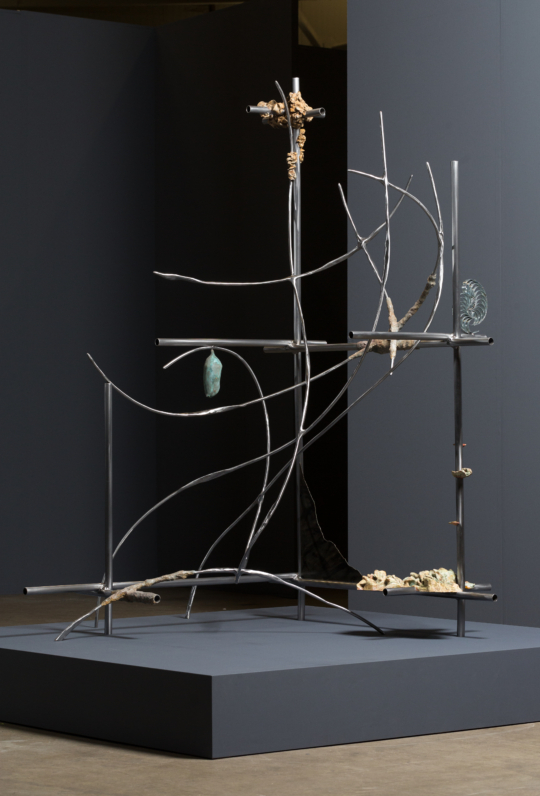
De natuur heeft zich genesteld in de industriële omgeving van Ahoy Rotterdam, het voormalige sportpaleis waar het nu bijna een sport is geworden om de nieuwste tendensen in de hedendaagse kunst te onderzoeken. Op het werk Apex (2026) van kunstenaar Michele Bazzoli (1996), bestaande uit een stalen structuur, hebben zich organische vormen gevestigd: een tribune van paddenstoelen die uit stalen mycelium ontspruiten, een mosselbank zonder water en een rups in transitie, op het punt een vlinder te worden.

De sculpturale elementen ogen als brons, maar zijn in werkelijkheid zorgvuldig 3D-geprint en met de hand beschilderd tot uiterst precieze representaties van de natuurlijke werkelijkheid. Bazzoli beschouwt deze vormen als niet-menselijke architectuur, waarbinnen een eigen systeem ontstaat. Als onderdeel van Prospects verkennen deze werken de verwantschap tussen het menselijke en het niet-menselijke, en de grens tussen het organische en het artificiële, of zijn deze juist onlosmakelijk met elkaar verbonden?

Zoals vorig jaar besteden we bij Tubelight opnieuw aandacht aan het residentieproject BIJ/NA, een samenwerking van St Joost, Van Gogh AiR en het Stedelijk Museum Breda, gepresenteerd in de Stadsgalerij Breda. Zes kunstenaars, drie recent afgestudeerden en drie kunstenaars die al wat langer in het vak zitten, presenteren de resultaten van hun residenties. Deze kunstenaars zijn Heba Bardan, Charly van der Eerden, Sam de Lange, Jitske Perdijk, Niek Opstals en Miekie Capello.

De ingang bevond zich aan de achterkant van het gebouw, niet aan de zijde van de Oude Vest, een schone straat met bezette bankjes en tulpenbedden. Om het hoekje van de Stadsgalerij loop je direct langs bouwhekken, een onverharde zandweg op waar een paar auto’s geparkeerd staan op peukengrind. Nog een hoekje om en de ingang komt in zicht, even smoezelig als de zijkant van het gebouw. Een van de kunstenaars was buiten zijn werk aan het opstellen. Achter hem hing een strokengordijn dat ouder leek dan hijzelf.

Toch bleek dit omlopen een enorme toevoeging aan de tentoonstelling. De smoezeligheid van buiten leek door het tochtgordijn naar binnen te zijn gelekt en zich daar stevig te hebben genesteld. De ruimte voelt intens geleefd aan: een collage van ongelijk gesneden houten platen, die waarschijnlijk op verschillende momenten aan muren en vloer zijn bevestigd om lekken te dichten en gaten te bedekken.

De kunstwerken vormen de laatste laag van die collage. Ze lijken elk moment uit elkaar te kunnen vallen. Ze bestaan uit klei, pvc, baksteen, hout, metaal, plastic en andere kunststoffen, elektriciteitskabels, zeil en gips. Materialen die je ook in en rondom puincontainers bij sloop aantreft. En hier begint het spel: het zijn juist deze materialen, die snel het stempel ‘zwerfafval’ krijgen en eindeloos blijven bestaan totdat iemand besluit ze op te ruimen, die hier tot leven komen.

Het materiaal sluit naadloos aan bij de thematiek. Het dier staat centraal, of beter: het dierlijke. In de manier waarop dieren zich tussen de benen van mensen manoeuvreren zonder vertrapt te worden, en nesten bouwen van bijvoorbeeld ijzerdraad.

Het is de vindingrijkheid van het dier die de vindingrijkheid van de kunstenaars accentueert. Zo lijkt de tentoonstelling een overleving van een onsuccesvolle strooptocht geweest te zijn: je kijkt naar wandwerken van restanten, een dierlijke sculptuur van installatiebuizen en decoratieve dingetjes van afvaltierelantijntjes. Soms zijn er ook werken te zien die puur uit natuurlijke materialen bestaan, maar op zo’n wijze gepresenteerd dat de interventie zowel menselijk als dierlijk van aard kan zijn.

Tegelijkertijd was er in het Stedelijk Museum Breda een solotentoonstelling van Anna Lange, waarin zij het alom vernietigende karakter van de mens benadrukt door het gebruik van aangereden wild in haar installaties. Het contrast met BIJ/NA is treffend, want het toont dat het niet aanpassen aan de wereld van de industriële mens, alleen maar kan leiden tot uitroeiing.

30 years ago, the Art Directions section of the International Film Festival Rotterdam was launched, immediately igniting an ongoing dialogue between digital technology and cinematic language that has continued until today. By migrating video works out of the black box of the movie theater and into Katoenhuis—an industrial cotton warehouse-turned-cold storage-turned art space—Art Directions has consistently pushed audiences to question: how do we perceive? How does our perception of cinema change when we are liberated from chronological time, or when we are free to move in space? This year, however, the installations in Katoenhuis pose an even more fundamental question: what can we perceive? What are the limits of our perception? The works, coming from The Democratic Republic of the Congo, the Netherlands, and Spain, each present a different challenge to viewers—whether that be bearing witness to a hostile military takeover, relaying a near death experience, recreating a volcanic eruption, or pulling apart the years of a marriage.

Café Kuba: Who Dared to Awaken the Dead Memory, David Shongo, 2025

Café Kuba: Who Dared to Awaken the Dead Memory, David Shongo, 2025

Opening the tour of Katoenhuis is David Shongo’s “Café Kuba: Who Dared to Awaken the Dead Memory”. The room is dark, illuminated by the dim light of three screens; a camera placed in a street vendor’s coffee cart captures nighttime scenes of Kinshasa, snippets of conversation, the glare of streetlights, a radio interview about government corruption. Every now and then, we see the inside of a van, three men ‘driving’ wooden vehicles with cardboard boxes on their heads and holding electronic waste and Belgian license plates. On the ground around the viewers’ feet, tires are scattered, filled with coffee beans and painted with the titles and dates of peace accords involving the DRC, in bitter contrast to on-screen flashes of text describing the M23 rebels’ violent 2025 takeover and the history leading up to it. In yellow letters against the black, Shongo asks: ‘how to film a space in which I myself become a fugitive’?

The answer: hidden, obstructed, in pieces, in disguise, in simulation. The black grille of the cart blocks out half of the scene, conversations are heard in passing, issues only directly addressed with scripted dialogues, and even then, the actors with their faces covered. In ‘Café Kuba’, Shongo reminds viewers that sight and hearing, like speech, are freedoms– but also a form of resistance.

Krakatoa, Carlos Casas, 2026

A deep rumbling across the hall calls to the visitor, drawing them into Carlos Casas’ “Krakatoa”. A screen hangs in the middle of a cavernous room, the air hazy and tinged with the glow from color-changing LEDs along the walls. On either side of the screen, platforms for viewers to sit shake intermittently with the thundering of the soundtrack. On screen, a lone fisherman goes about his daily chores on his boat. He cooks, he repairs his net. The sun sets. And then a flare of red and a deafening, primordial scream. The fisherman is cast overboard and washes up on the shores of a post-apocalyptic island, drawn hypnotically further and further inward to witness—along with the viewer—the core of the earth. 

Considered the loudest modern sound ever heard at 310 decibels, the 1883 eruption of the Indonesian Krakatoa volcano becomes an experiment in perception for Casas, who uses his silent protagonist as witness to a nature normally inaccessible to man. As the fisherman ventures from the island’s barren crust into its volcanic depths, reality becomes abstract, vision breaks down, sound becomes overwhelming. The man’s eyes fill the screen as he gazes upon the subterranean inferno of molten lava, and then the image flickers and the eyes become rock face flaming red, back and forth until the fisherman is subsumed into what he is witnessing. The image goes white, the mounting rumble flatlining into a single high, piercing tone. Flashes fill the screen, molecules, minerals, particles— a microscopic view of each element contained in the earth on the way inward to its core. Visual processing breaks down, images are overlaid with afterimages, and even when the screen goes blank, colors and shapes continue to bloom on its surface. Then the island at sunset, empty—peaceful. The gentle lapping of waves against sand as the day falls into twilight. The fisherman is gone.

In “Krakatoa”, Casas weaves destruction and creation, violence and peace so tightly as to make one indistinguishable from the other. The disappearance of the human presence is presented not as a death, but as a transcendence: becoming as the absolute form of perception. 

Preludio, Silvia Gatti, 2026

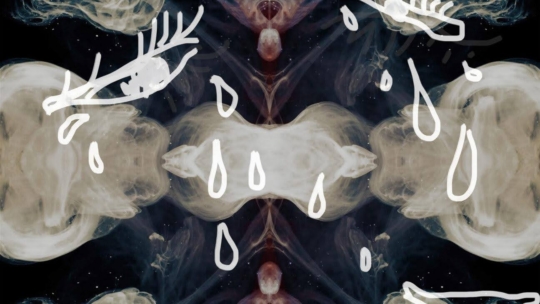
Unmoored, the viewer drifts into Silvia Gatti’s “Preludio” and is immediately enveloped by the soft sound of falling rain, a heartbeat, birdsong. Twisted metal litters the ground in front of the screen, the detritus of a wreck. But the atmosphere is tranquil. A loop of words: ‘peace’ ‘body’ ‘do not fear’, raindrops on glass, an animation of crying eyes, brain scans. And gentle humming, a mother’s lullaby. 

Originating from the artist’s near-death experience, “Preludio” unfolds in a series of impressions, a ‘sensory architecture’, responding to a specific challenge—how to consciously perceive the subconscious, even the unconscious? Gatti turns to two seemingly opposing elements to do so: the natural and the digital. The soft soundscape juxtaposes the neon pink of the words on screen; a mother’s singing with brain scans, the visitors’ own body with the lines of wires snaking across the floor. The viewer is painfully aware of the electrical pulse of the brain that makes their perception of the world possible, aware that these impressions, memories, sights and sounds would disappear if the power were unplugged. Gatti constructs a limbo, a pre-waking world that feels close to both childhood and death, a fragile space where, however, one wants to stay. 

3 Scenes From a Marriage, Leopold Emmen, 2026

Finally, continuing up the stairs, the visitor ends up in Nanouk Leopold and Daan Emmen’s “3 Scenes from a Marriage”. There’s the immediate sense of having wandered onto the back lot of a film that’s finished shooting. Flimsy papered walls held up by sandbags, a miniature model of a house, a pile of belongings that look like props give the sense of a domestic space in the process of being dissembled. The titular scenes from the marriage are projected onto the walls, the curtains, inside the miniature house. There’s no conflict between the couple—in fact, there’s intimacy, touch, stares as they embrace. Yet there’s a coldness, both to the images and to the room, that transmits the pervasive feeling that something here does not work, has not worked. And the viewer, working their way through the space, becomes certain of it when they notice the details; the faucet is upside down, there are far too many glasses on the table, the video projections are oversized for their supports and spill over into emptiness. Two single mattresses lie awkwardly on top of one another. 

“3 Scenes From A Marriage” tackles the limits of our perception of time, choosing to show the sum total of a relationship simultaneously, turning time into a physical space and a unified object. Stories live inside one another, just as the miniature house exists within the larger set, and moments become infinite—a corner of a kitchen implies countless mornings, countless conversations, and the videos keep looping, over and over again.

Perhaps it is because the visitor can’t quite shake the very real danger of “Café Kuba”, or because the rumbling of “Krakatoa” can be heard throughout the halls of Katoenhuis, or perhaps because the scattered metal shrapnel of “Preludio” somehow parallels the domestic wreckage of “3 Scenes”, but there is a motif of explosion in the four installations featured in this year’s Art Directions—a violent release of energy when the world we’ve been trying to hold together finally overwhelms us. Only then do we realize the limits of our ability to impose order and sense onto things. Yet we can perceive that there is more, beyond, and each of the artists in Katoenhuis, in their own way, rethink the cinematic medium in order to show what can’t be seen. 

Nathan Douenburg

Het jaarlijkse gerenommeerde design evenement van Nederland vond vorige maand weer plaats in Eindhoven: De Dutch Design Week (DDW). Namens Tubelight ging ik dit jaar op pad om als zelfbenoemde ‘Junior design writer’ de werken van de Design Academy Eindhoven (DAE) te beschouwen, te belichten, of te bekritiseren.


Eerste punt van kritiek: Persaccreditatie aanvragen kon vanaf dit jaar via een website, mits je al een publicatie hebt op je naam. Dit artikel is niet alleen een recensie maar ook een investering in volgend jaar. Tweede punt van kritiek nu we het toch over het digitale-DDW-domein hebben: Mijn favoriete feature op de website is nu verplaatst naar een app. Het ‘liken’ en uitstippelen van de route kan niet meer in de browser helaas. Vandaar dat ik uit protest heb besloten om een analoge visuele samenvatting van drie dagen DDW te maken. Ofwel een collage, voor de design professionals onder ons.

Nog steeds ziet men ‘design’ vaak als mooie zout en pepervaatjes. Tegenwoordig toont de DAE graduation show een diaspora aan werk, waar design in al haar facetten ten tonele komt. In deze review neem ik je mee op dag twee, met naar mijn mening de meest intrigerende werken van deze afstudeershow.

in het donker van de Microstad parkeergarage stuit je bij binnenkomst meteen op meerdere film en video werken. Een van de meest intrigerende videowerken is Citizen Chairs of Beirut — Sequences of a Fragmented City van George Baida. De iconische Monobloc tuinstoelen staan versmolten als sculptuur voor een videoportret over Beirut. Tevens vormen de Monobloc sculpturen ook een nieuw doek waarop wordt geprojecteerd. Het film-essay onderzoekt door het in beeld brengen van stoelen op straat het dagelijks leven en de politieke situatie in Libanon. Het essay is een lust voor het oog, waar elk shot een zoektocht wordt naar een stoel. Juist het samenspel tussen sculptuur en video maakt het tot één van de meest aantrekkelijke videowerken van deze show.


Toch moet ik wel constateren dat er enige vorm van ‘filmflatie’ is dit jaar. In vergelijking met voorgaande jaren zijn veel werken louter videobeeld, en daardoor een investering om volledig te bekijken. Zelf vind ik dat een moeilijk gegeven aan gezien design altijd een focus heeft op ‘het materiële’. Vandaar mijn fascinatie met Baida’s werk. Ook kan ik een hele tentoonstelling maken van alle digitale werken met een stekker die uit stonden: Waar een persoonlijke laptop zichtbaar in de expositie stond, je tijden het spelen terechtkwam in iemands persoonlijke laptop, of de uiteindelijke interactie niet bleek te werken. Onprofessioneel op z’n minst. Het werk wordt gereduceerd tot alleen een bordje met tekst. Dat terwijl design zo goed voor zichzelf kan spreken, maar niet als het uit staat.

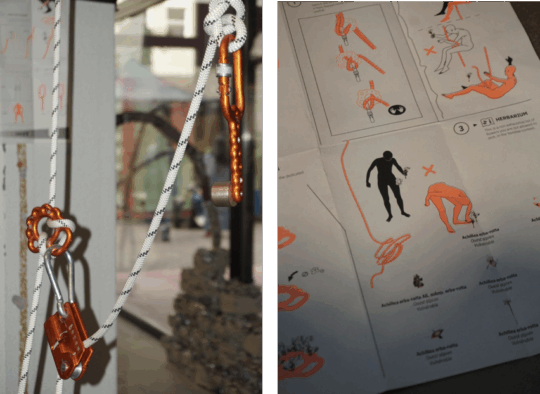
Een van de daadwerkelijke ‘producten’ onder de afstudeerwerken die ik wil belichten is Not For Climbing van Marie de Lavergne de Cerval. Een uitstekende combinatie van prikkelend conceptueel design en daadwerkelijk industrieel product ontwerpen. Zoals het de naam betaamt (en de tekst op een karabijn haak van de Gamma stelt), is deze klimuitrusting not for climbing. Deze conceptuele herontwerpen van de karabijnhaak laten verschillende profielen van interactie tussen mens en omgeving zien. Waarbij er ook horizontale relaties met de berg die beklommen word kunnen ontstaan: Van een danser die vrij beweegt tussen het gesteente, tot een bloemenplukker die de bergen bij zich wil houden. Het presentatiemateriaal is van dermate kwaliteit dat het zo in productie genomen kan worden, waarnaast het een concreet conceptueel voorbeeld is van het opkomende More-than-Human Design. Al met al, een werk om vanuit de bergen over naar huis te schrijven.

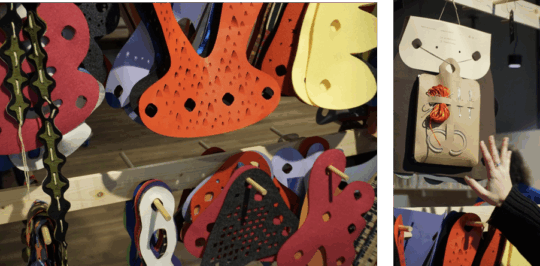
Het is dan misschien geen fashion week, maar interessante projecten rondom mode, kleding, en design zijn zeker te vinden. Het werk The Wardrobe is Open van Emilie Sandré is zo’n werk over kleding dat blijft hangen. Een set aan gerecycled textiel in speelse en kleurrijke vormen waar kinderen zich mee kunnen verkleden. Dit werk maakt niet alleen nieuwsgierig naar alle combinaties, maar is tot in de puntjes uitgedacht. Met een reparatie set, en verschillende vormen van ‘verbinders en riemen’, om het te hergebruiken en eigen te maken. Deze modulaire kostuums zijn meer dan alleen duurzaam en genderneutraal. Jaloersmakend dat je dit niet in je eigen jeugd had als je de kinderen met dit ontwerp in actie ziet.

Als laatste wil ik de ruimte nemen voor een van mijn favoriete regionen van design: Keramiek. Twee werken die in de tentoonstelling perfect zijn gepositioneerd zijn de werken Imperfect Ceramics van Aljosha Grégoire en World’s Best Mug van Astrid Vagner Thomsen. In deze hal staan deze twee werken lijnrecht tegenover elkaar, ook in concept.


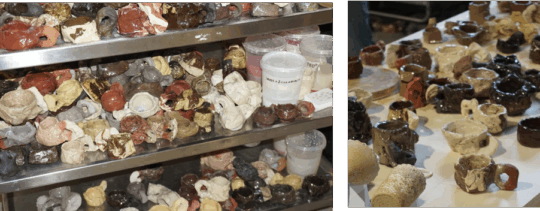
Om te beginnen Imperfect Ceramics, een zoektocht naar efficiënte en imperfectie. Een overdadige collectie aan mokjes en kopjes. Met een zo efficiënt mogelijk systeem wordt de klei en masse gepromoveerd tot drinkbeker. Toch is het resultaat aan de buitenkant ruig en onafgewerkt. Het is een overweldigende hoeveelheid met gevulde tafels en karren. Één van de weinige exposities waar het ‘do not touch bordje bewerkt moest worden tot een ‘do touch bordje’. Dit werk is een voorbeeld van een uitvoerig en verrassend design research project, helaas wel zonder ‘goodybag vol met mokjes en kopjes’.


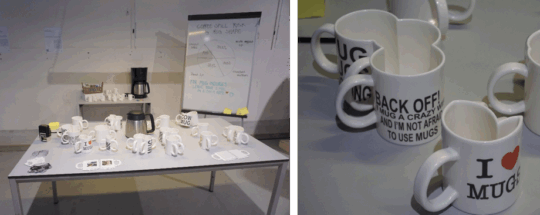
Daartegenover staat World’s Best Mug. Tegenover de speelse imperfectie staat een afstudeerwerk ‘onder het systeemplafond’: Een tegenpool niet alleen in thematiek maar ook esthetiek . In dit werk wordt de hedendaagse kantoorcultuur bevraagt aan de hand van de koffiemok. De koffiemok is volgens Vagner Thomsen een middel van zelfexpressie in een monotone kantoorcultuur. Deze samengesmolten mokken lijken industrieel vervaardigd, maar zijn het resultaat van uiterst gecontroleerd handwerk. Naast dat dat al een prestatie is an sich, zijn deze mokkende mokken ook sprekend onderzoek naar vormgeving, en conformeren door middel van design.

Al met al was deze Dutch Design Week één waar het analoge en materiële werk de spotlight verdient. De werken waar het meest voor zichzelf wordt gesproken zonder digitaal hulpmiddel, dat is waar de recente DAE alumni hun kracht in vormgeving laten zien. Design mag mooie zout en pepervaatjes zijn, waarnaast ook sprekende mokken, jaloersmakende verkleedkleren, conceptuele karabijnhaken, en geportretteerde plastic stoelen.

Alle foto’s zijn gemaakt door Nathan Douenburg

Nathan Douenburg is een multidisciplinair ontwerper (TU Delft Design For Interaction MSc.) en schrijft graag over de sociale/culturele/historische kant van design vanuit zijn achtergrond in design geschiedenis (VU Amsterdam Design Cultures MA.).

By Rita Ouédraogo

The puppet king dies every year, and every year he returns. In Curaçao’s Karnaval tradition, King Momo, the corpulent figure of collective catharsis, embodies a paradox fundamental to cultural continuity: temporary structures that recur, endings that contain future beginnings. As my tenure at Buro Stedelijk concludes with Kevin Osepa’s exhibition The Belly of Momo, I find myself dwelling within this same paradoxical space: the hollow stomach where spirits rest between celebrations, where mourning and possibility coexist.

Institutional Bellies and Liminal Architectures

Liminality as a threshold state, neither here nor there, where social structures temporarily dissolve, bellies extracting the life-force and recycling less desirables back into our collective earth. Project spaces like Buro Stedelijk function as institutional bellies. Liminal zones within larger cultural bodies where experimental voices gestate, where hierarchies might briefly suspend, where what cannot be spoken elsewhere finds place. These spaces shape themselves to temporariness, and open up onto the magic that is timeless alongside multifaceted temporalities. Yet their impermanence, their ability to be many things at once, and to negate themselves as a protective strategy is precisely what grants them freedom.

When artist Kevin Osepa spoke about Buro as “a space within an institution that dares to imagine the unthinkable,” he identifies what makes temporary structures culturally vital, even questioning the very underpinnings of what ‘culture’ means alongside ‘art’ and ‘aesthetics’. As Rizvana Bradley argues in Anteaesthetics (2023), such spaces operate from the negative underside of form, where artistic practices can interrogate the very structures that claim to contain them. Unlike permanent institutions weighted by legacy and accountability to established narratives, project spaces can hold contradiction. They can be, as David Rudder says of Curaçao, places where “one plus one is eleven” — where ‘colonial mathematics’ no longer apply, where new equations become possible. 

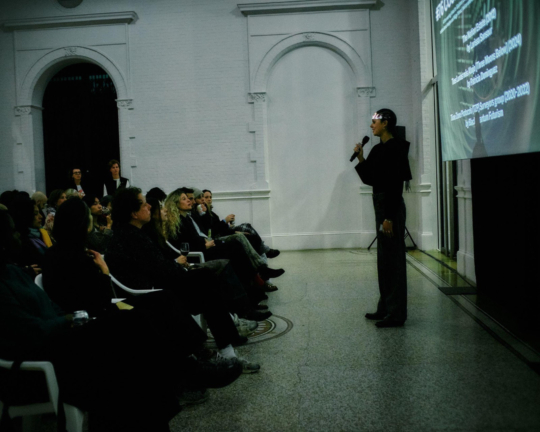
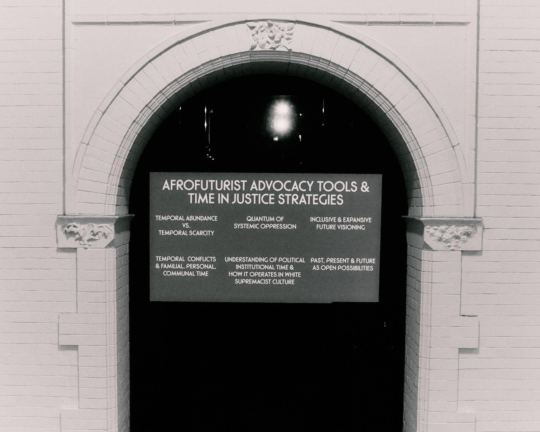
This resonates with Black Quantum Futurism’s reimagining of space-time itself, where marginalized communities’ temporal experiences, their ancestral memories and future visions, challenge Western linear chronology and create what Camae Ayewa and Rasheedah Phillips of Black Quantum Futurism, term “community futures.” Such alternative temporal logics found expression at Buro Stedelijk through Manifestation #76 Cosmic Entanglements, where Black Quantum Futurism’s documentation of the Time ZoneProtocols (TZP) Surveyors group examined how colonial time standards lock Black communities out of past and future, confining them to a narrow temporal present. The film’s presentation within the ‘Goddess Change’ speculative fiction reading group, convened by artists Anna Hoetjes and Müge Yılmaz, exemplified how project spaces can host practices that examine new relationships to space-time through specific social, geographical, and cultural frameworks departing from colonial linearity.

Curatorial work, particularly in temporary spaces, cannot but share kinship with ritual practice for we create containers for transformation, orchestrate encounters between objects and publics, mark transitions. Against permanency and its violent histories, kinship offers something else entirely: not just survival, but joy. The exhibition itself is inherently temporary. A gathering that will disappear, a configuration that will dismantle. Yet like Karnaval, its ephemerality does not diminish its power. Rather, the knowledge of its ending intensifies presence.

Throughout my time at Buro Stedelijk, each manifestation has been a small death and rebirth. Artists arrive, spaces transform, publics gather, then disperse. Works are deinstalled, walls repainted, the space holds its breath before the next arrival. This cyclical temporariness has taught me that curatorial practice is less about preservation than about creating conditions for emergence and then, gracefully stepping aside.

Manifestation: #76 Cosmic Entanglements Buro Stedelijk, Rita Ouédraogo. Photo by Dre.

Manifestation: #76 Cosmic Entanglements Buro Stedelijk, still from Black Quantum Futurism that documents the Time Zone Protocols (TZP) Surveyors group. Photo by Dre.

Chanting “Ayo Momo”: Collective Mourning as Creative Act

During the final manifestation, Manifestation #80: the Belly of Momo, with Kevin Osepa, our last exhibition at Buro Stedelijk, we chant ‘Ayo Momo’… We cleanse the space, leaving behind a spirit. This cleansing is not erasure but honoring. An acknowledgment that something lived here, that bodies gathered, that noise was made. In many West African traditions, from which Caribbean cultural practices draw, funerary rituals are not merely about grief but about ensuring proper transition, about feeding ancestors so they might continue to guide the living. Together with artist Kenneth Aidoo, last year during his manifestation at Buro Stedelijk, Manifestation #42: Tell It Like It Is, we organized a funeral for his major mural. A moment to celebrate and mourn an ending.

What does it mean to mourn a project space? To grieve not a person but a possibility structure, a set of relationships, a temporary commons? Our mourning must be collective because what we built was collective. The value of Buro Stedelijk never resided in its physical walls but continues to thrive in what those walls permitted: the nurturing of communities that thrive despite, what Wayne Modest as an important voice and mentor have shown in his work at the RCMC, conversations, kinship between and among people, experiments that larger institutions deemed too risky, platforms for artists whose practices refused easy categorization.

When we cry together, as Osepa suggests, we perform necessary cultural work. We refuse the neoliberal demand that endings be efficiently processed, cleanly transitioned, immediately productive. We insist instead on sitting with loss, honoring what was, acknowledging that some things cannot be replaced, they can only be transformed (temporally).

Manifestation #39:To Be Determined – Buro Stedelijk – (October 2024) Rita Ouédraogo and Kenneth Aidoo in front of Kenneth Aidoo’s mural in Buro Stedelijk’s Central Space. Photo by Anne Lakeman.

The Belly as Generative Void

In Manifestation #80: The Belly of Momo, we frame the belly as a place for temporal possibilities. Where the unspoken and the hidden reside in their purest form. The marginal

spaces, edges, thresholds, hollows, that hold particular power because they exist in the inbetween. The belly is void and full simultaneously, absence pregnant with presence.

As I prepare to leave Buro Stedelijk, I recognize that this ending creates a void, for me in this moment, but filled already by the ongoing kinships that thrive. But voids are not simply empty; they are spaces of potential, sites where new arrangements might crystallize. The question is not what will fill this particular space, that is for others to determine, but what seeds we have planted, what spirits we have fed, what practices we have modeled.

The Belly of Momo offers a framework: the show itself becomes a ritual space where audiences don’t merely observe but enter into relationship with Karnaval’s coded visual and affective language. We ask visitors to be entangled, to allow their perspectives to flip, to surrender certainty. This is what temporary structures can offer. Permission to not know, to dwell in complexity, to trust that meaning emerges through embodied encounter rather than didactic explanation.

What Grows When Certainty Dies

Institutional cycles closing, create opportunities to examine what emerges from creative endings. In Caribbean cosmology, death is not terminus but transition. Ancestors remain active participants in community life; past and present interpenetrate. King Momo dies each year but his spirit persists, informing next year’s incarnation.

Perhaps this is what grows when certainty dies: a more honest relationship with impermanence, a recognition that all our structures are temporary, all our gatherings will disperse. Project spaces like Buro Stedelijk make this truth visible, but it applies equally to larger institutions, to artistic practices, to curatorial careers. We are all King Momos. Temporary vessels for energies larger than ourselves, puppets animated by collective desire for spaces where “one plus one is eleven.”

The gift of mourning institutional endings is that it forces us to ask: What was this for? Who gathered here? What became possible, however briefly? These questions cannot be answered through metrics or reports but only through embodied memory. The warmth of bodies in a small room, the electricity of seeing an artist’s vision fully realized even when it seemed impossible, the quiet satisfaction of knowing we, together, always together, created conditions for encounters that might not have otherwise occurred. We will emphasize the importance of remembering. How we gathered and how we made noise. Noise as refusal of silence, insistence on presence, disruption of dominant frequencies. Throughout its existence, Buro Stedelijk has amplified voices often marginalized within mainstream Dutch cultural institutions, artists navigating colonial legacies, practitioners working at intersections of art and activism, experimental approaches that resist market logic.This noise will not be silenced by physical closure. Like King Momo, like ancestral spirits, like Karnaval itself, the practices we have nurtured will find new containers, new bellies in which to exist. Artists will continue making work, publics will continue seeking spaces of complexity and contradiction, curators will continue creating platforms for the unthinkable.

My own next chapter remains unwritten, but I carry forward lessons learned in this temporary structure: Trust impermanence. Create conditions for emergence then step aside. Honor contradiction. Make space for noise. Recognize that even endings are not final, they are transitions, thresholds, hollows pregnant with future possibility.

Manifestation #80:The Belly of Momo, Kevin Osepa (2025). Photo by Kevin Osepa.

In Conclusion: Feeding the Spirit

As we prepare for this final exhibition, this last gathering, I think about ritual as technology, ancient wisdom for processing transition. We will cleanse the space not to erase but to honor. We will chant “Ayo Momo” knowing that goodbye is not abandonment but acknowledgment. We will feed the spirits, the ancestors, the artists, the publics, who have animated this space, trusting they will continue to guide us.

The belly of Momo will empty again. The space that housed Buro Stedelijk under my curatorial vision will transform into something else. But the impossibilities we dared to imagine here, the hierarchies we dissolved however briefly, the noise we made together, these persist. They are seeds scattered, waiting for new soil, new bellies in which to grow. In mourning this temporary structure, we honor all temporary structures. We acknowledge that everything we build will eventually dissolve, and we choose to build anyway. We recognize that institutional endings, like carnival cycles, are not failures but completions, necessary deaths that make space for new life.

One plus one does not equal two. In the mathematics of cultural memory, of collective practice, of temporary structures that dare to imagine otherwise, one plus one is eleven. The belly empties, but it will fill again. King Momo dies, and King Momo returns. We say goodbye, and in that goodbye, we plant the seeds of future gatherings yet unimagined.

Ayo Momo. Ayo Buro Stedelijk. Until we gather again, in whatever form, making whatever noise the moment requires.

Rita Ouédraogo is an Amsterdam-based curator, art and culture consultant, researcher, and writer who has built a practice at the intersection of arts and research. Drawing on Black feminist pedagogies and memory work, she interrogates colonialism and its afterlives in Europe and the Caribbean, while challenging institutional power. Her work amplifies narratives of marginalized publics through archives, critical pedagogies, and collaborative methodologies that operate both within exhibition spaces and beyond them.

‘OMG GOOD COCK AND BAD COCK BROKE INTO MY EXHIBITION!’ – NELLY DANSEN

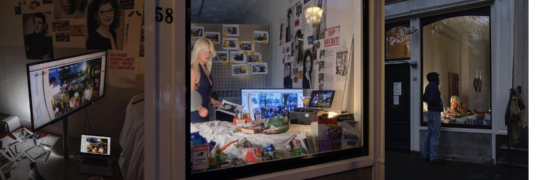
Between May 22nd and 24th, I staged my piece Smile :) You’re on Camera behind a glass window at the Geldersekade, as part of ‘The Living Room’ series curated by performance collective Trespassing: A series of performative interventions in the (semi-)public space that navigate between the thresholds of the private and public, exhibitionism and voyeurism, and of social cohesion and estrangement (what a mouthful of a sentence). By ways of aesthetic disruption, The Living Room series invites onlookers to linger a little longer whilst they are encouraged to contemplate upon the questions posed behind these windows.

Earlier this year in April, I showed my video work GOOD COCK BAD COCK at the same space, a short film I made after getting deported from the United States when my film Head Over Heels raised some suspicion. I missed the opening of that event because I was kettled by police with a group of other protesters during a peaceful pro-Palestine march on the Zuidas…(a gentle reminder that control operates not only through surveillance technology but also through state power and policing. BUT! We will dive into that later…)

All too often, my work collides with The System™. On the opening night of May 22nd, I was actually on time for once  (history was made). But so were some uninvited guests, arriving fashionably early and dressed in full authoritarian chic: The Cops™. Oink Oink.

The installation

‘Smile :) You’re on Camera’ was a three-day-long performance installation, positioned right in the center of a front window that faced the street. It featured a live-feed surveillance camera mounted outside the building, projecting real-time footage of passersby and visitors onto a TV screen placed inside the space. This simple setup flipped the gaze: turning viewers into the viewed, spectators into spectacle. On the walls of the room, posters of Foucault, Orwell, and Deleuze hung like silent overseers, framing the work in Theoretical Tension™ and inviting the audience to reflect on power, control, and visibility.

I draped myself in the room too, performing the role of a visible Big Brother, watching people on the screen while simultaneously watching Big Brother USA, season 12 from the comfort of my own Surveillance Man Cave™  (whatever that means…).

The installation used camp aesthetics to exaggerate traditional Surveillance Vibes™ like CCTV, but ultimately, it pointed toward something more intimate: the internalized surveillance many of us carry. Though for some, it starts earlier and runs deeper. Especially if you’ve moved through the world in a body that was always already being watched.

“The surveyor of woman is herself male: the surveyed female. Thus she turns herself into an object, and most particularly an object of vision: a sight.” – John Berger, Ways of Seeing

That quote resonates deeply, but for me, in the words of my friend Matilda, it resonates even more:

“I was thinking of surveillance today, and how I really don’t care about being surveilled, but a bunch of guys do. So classic, women have been self-surveilling since the dawn of their puberty. Who cares about a bunch of cameras watching you when you are always already watching yourself?”Matilda Elofsson, Whatsapp Chitchattery

Literally. 

Now, in the digital age, that gaze is even harder to escape  and often it also lives inside our own minds. We curate and package ourselves. That logic of visibility, of managing one’s appearance in a performative loop, wasn’t just something I was thinking about during the making of this work. It was literally taped to the wall.

The surveillance camera I used was no fancy-schmanzy, high-tech security device. It was a cheap thing, duct-taped outside of the gallery like a last-minute solution, or a desperate attempt at control. It didn’t scream authority and that was exactly the point. By choosing a visibly visible crappy setup, I wanted to strip the surveillance aesthetic of its usual invisibility. No seamless or sleek angles. Just exposed cables and tape. A kind of bimbo-bureaucracy aesthetic… Ohhh how I <3 Duct-tape…

The footage fed into a basic TV screen inside the space, not a monitor like in a control room, but something more domestic and DIY. Visitors saw themselves as lo-fi versions Beamed into my Bedroom. This broken infrastructure mirrored how we self-surveil: imperfectly, obsessively, without knowing if anyone’s even watching. The absurdity of a taped-up camera surveilling people who voluntarily stop and look at themselves, in an artwork that critiques that very gaze, created the loop I was after.

As I said, I was part of it too: lounging inside my bedroom slash Surveillance Man Cave™, watching Big Brother USA while occasionally peeking at the surveillance feed. Authority, NELLY DANSEN: Head of Gaze Operations, was disinterested, performative and half-watching. And that felt true. Because most of the time, no one is really watching. We’ve just learned to behave as if they are. Even a duct-taped system still makes us pause, do a posture correction, and check how we’re seen. Even duct-tape DIY surveillance still works.

The Gaze

That feedback loop of visibility, being the watcher and the watched, is what I really wanted to explore. Not just as a metaphor, but as something I’ve been living through, especially in relation to NELLY DANSEN: the performative persona I created, who lives both online and offline. At first, I thought I was constructing her, shaping her identity as a tool, a persona, a character. But at some point, the dynamic shifted. It started to feel like she was creating me. That’s the paradox of identity today; especially when it’s performed, archived and mirrored back. You become the observer and the observed.
Observation and visibility is never neutral; it always carries power dynamics. It shapes how we’re perceived and eventually, how we perceive ourselves. I remember working at a nightclub where one of the house rules was something along the lines of “don’t stare at someone too long,  it can be intrusive ”. That rule really stuck with me. Also in a club context, the gaze was recognized as something with weight, something that could cross a line. I wanted to explore that same logic during the performance. It wasn’t just a campy performance of surveillance; it mirrored how deeply “being watched” is woven into all aspects of our lives, and how uncomfortable that presence can feel. The gaze doesn’t need to be a high-tech surveillance camera to be powerful. It just needs to be there.

The Shift

And then, suddenly, that violence I was reflecting on showed up right at my doorstep.

During the final prep, half an hour before the opening of SMILE :) You’re on Camera, a man was stabbed right outside the gallery. Later, he was shot in the leg further down the street. Police showed up quickly and blocked off the entire area. Luckily, the victim is physically okay, but the whole situation shattered the distinction between performance and reality within a second.

From inside the space, we watched everything unfold in real time through the surveillance camera I set up as part of the work, making for a disturbingly dystopian moment. What happened went beyond performance.

But it also expanded the performance, wildly. Up until then, my work focused on surveillance as a metaphor, especially how it shapes femininity, performance, and the internalized gaze. But what happened outside opened it all up. Suddenly, it wasn’t just about being watched, but about surveillance as state power: as policing and as control. 

There’s an irony here that can’t be overlooked: one of the main arguments in favor of CCTV and surveillance is that it helps police catch criminals and ‘keep us safe’. Yet at this moment, my installation ended up becoming part of that system, blurring the line between critique and complicity.

After things settled, we walked  outside for a bit to decompress. When we came back, we found that the police had entered the gallery without our permission (…the real trespassers). One cop even admitted his surprise to finding that the presenting artist was female. “This has a very masculine look,” he continued. They stood beneath the Orwell poster (who they apparently thought was Elvis Presley), flipped through the July 2024 Playboy featuring me on the cover, and walked right over my printed-out surveillance footage. The installation, which looked like an absurdist explosion of surveillance evidence, was now being treated as actual evidence. IT specialists tried to pull footage from the surveillance camera; which ultimately failed (Ha!! Their power is not absolute!) , and I was informed that they would try again in the morning. Which failed again… 

As I’ve lovingly referred to her before: my Crappy Camera was one bought online for cheap. Turns out; the camera had been blacklisted for use in Dutch government buildings because it streamed directly to a cloud server somewhere in China and had no internal storage. All the authority… all the urgency… undone by a cheap camera with no hard drive. My installation may have looked like evidence, but its real function was revelation. Not of crime, but of fragility. The state came looking for clarity, and was met with duct-tape, bad WiFi, and a cloud server I didn’t even know existed.

And yet… There I stood that night; still shaken by what happened outside, standing in my own installation surrounded by cops. At that point, the staged reversal of power fell apart. C’est moi, The Artist, got turned into data custodian under the watchful eye of the state. While I positioned myself in the work as Head of Gaze Operations, the ‘real’ gaze; the authoritarian gaze, showed up in uniform. 

The irony dripped like …

The whole thing felt Baudrillardian: the line between simulation and reality completely disappeared. In other words, what was supposed to be a critical performance blended right into the real-world system it was critiquing. A hyperreal moment where both folded into one.

The room watched. 

The room was watched. 

The gaze became real, not just symbolic.

This wasn’t the opening night anyone expected.

But somehow, it reveals truths clearer than any script could.

The Aftermath

Shortly after the incident, Het Parool covered the story. The article ended with the line that installation became officially part of the full police investigation. Which added some extra gravity; seeing it written out like that in the newspaper. It was now public and archived in official history.

And to be honest, I was relieved the footage wasn’t saved. Not just because the tech failed, but because I didn’t  feel like intervening or assisting law enforcement.  The situation outside was complex, and I didn’t feel comfortable handing over data that could criminalize people, especially when they looked so young. This exposes the lie at the heart of the “CCTV keeps us safe” argument. Safe for who? Surveillance doesn’t guarantee justice, it enforces power. It captures what’s useful to the state and discards what isn’t. 

The Bias

What stayed with me after the whole thing wasn’t just the chaos, it was the question of who gets protected, and who gets erased. Surveillance isn’t just about watching; it’s about deciding what gets seen, what gets saved, and what gets deleted. It’s a tool of power, not justice.

While the state will extract footage from a gallery (without asking), it’s also perfectly capable of deleting it when violence doesn’t serve the oppressor’s narrative. 

Look at the recent news about ‘lost’ CCTV footage of the Maccabi supporters attacking people in Amsterdam in November 2024. A woman shouted “Free Palestine” in a metro station and was violently attacked; hit, spat on, and had her hair pulled by some of the Tel Aviv soccer club hooligans. She later gave a formal statement detailing the assault. The entire incident was caught on camera. And yet, for some very suspicious reason, the footage was deleted by the GVB… 

How convenient…

What this highlights is another larger truth about surveillance. Surveillance isn’t neutral memory-keeping. It’s actively forgetting when the narrative doesn’t serve power. It archives selectively, to punish some, and protect others.

The End

Right now, I’m sitting in the canteen of De Leeuwarder Courant, writing this article (while Gasolina blasts through the speakers… Can a girl focus??). It’s unofficial ‘Bring Your Child to Work Day’ as I’m visiting my mom. While she wraps up some things for the paper, I’m here writing this piece, as an artist-posing-as-article-writer, in a newspaper office.

Another hyperreal moment. Watching myself write about watching, inside a place that literally becomes public record.

I guess that is the full circle. I started this piece as an installation, then it turned into an investigation and now I am documenting and archiving it in a newsroom. 

Artist / Persona
Gallery / State
Critique / Complicity

Performance becomes Evidence. 
Art becomes Archive. 

The line blurs, again. 

XOXO, 

NELLY DANSEN

PS. Big Boobies Are Watching You!

References

Books and Theorists:

  • Foucault, Michel. Discipline and Punish: The Birth of the Prison. Vintage Books, 1977.
  • Orwell, George. 1984. Secker & Warburg, 1949.
  • Deleuze, Gilles. “Postscript on the Societies of Control.” October, vol. 59, 1992.
  • Berger, John. Ways of Seeing. BBC and Penguin Books, 1972.
  • Baudrillard, Jean. Simulacra and Simulation. University of Michigan Press, 1994 (original 1981).
  • Eloffson, Matilda. Whatsapp Chitchattery. Whatsapp, 2025.

News Articles:

The Harvard Sensory Ethnography Lab was established in 2006 by ethnographer and filmmaker Lucien Castaing-Taylor when he found himself in a predicament. He had recently moved from Colorado to Cambridge to take up a teaching position at Harvard, but the Anthropology department wanted him to teach filmmaking, and the filmmaking department would not have him. So he carved out his own space between the two, setting up the Lab as a space for experimentation in the field of Sensory Ethnography.

According to Castaing-Taylor, there is no strict definition of Sensory Ethnography. As described on the Harvard website, the Lab “encourages attention to the many dimensions of the world, both animate and inanimate, that may only with difficulty, if it all, be rendered with words”. Castaing-Taylor’s work, deeply influenced by his collaborations and interactions with Lab participants and colleagues, spans an eclectic range of subject matter, from the 2009 Sweetgrass, documenting modern-day shepherds, to his collaborations with Verena Paravel like Leviathan, about the commercial fishing industry, and the more recent De Humani Corporis Fabrica, following life – and death – inside a French hospital. 

Since its founding, the Lab has platformed a number of innovators in the field, including Diana Allan, Stephanie Spray, J.P. Sniadecki, Nnenna Onuoha, and Ernst Karel, and works produced through the Lab have been exhibited and screened at majorbiennales, museums, and film festivals around the world.

Could you briefly define Sensory Ethnography and your approach to the practice? 

No! I can’t. Actually. I chose the name because it is more evocative and suggestive than prescriptive and precise. Strictly speaking, it’s kind of meaningless, no? What is ethnography, anyway, in this day and age? At its core there is supposed to be a “method” anthropologists call “participant observation.” But what is that, really, when push comes to shove? As a philosopher friend of a friend put it, anthropologists had the genius (or delusion) to choose as their own putatively sui generis methodology what is simply the human condition. Something shared by us all. I mean, who doesn’t observe life, and who doesn’t participate in life, in one way or another? And which of us is not a sensorial creature? So there is no strict definition of it. And sensory experience is really infinite in its nature, however circumscribed it might be by biology, society, culture, politics etc. I called the Lab that because anthropologists have a bee in their bonnet about being the one social science or humanities discipline that gets out of the “library,” or off the “verandah,” as they say, and studies the real world in more qualitative than quantitative ways. But they remain, at their heart, what we might call cultural textologists. They are much more oriented towards the discursive than the figural, and in forms of cultural “meaning” that can be rendered in language, especially propositional prose, than they are in what we might call the plenitude of being – very little of which can ever be expressed in language. We are sensing, somatic creatures before we are semiotic ones, and academics need not to forget that, rather than constantly seeing to convert everything into their own (super reductive) discursive, disciplinary currency.
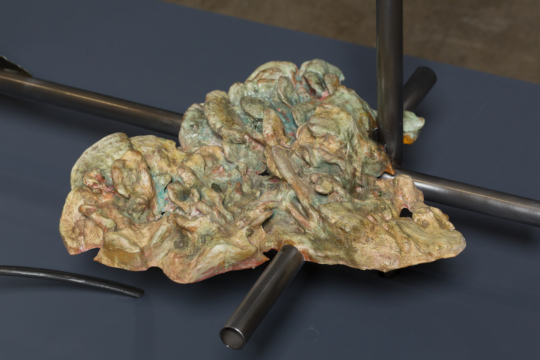
The work of the Sensory Ethnography Lab lies at the crossroads of various disciplines– film, contemporary art, and academia. How is the practice viewed differently in each field? 

I don’t really know, or to be honest, care, how we are viewed by these different fields. It’s hard enough to make original work; I don’t really have the time or interest to gauge how it is perceived by others. I am not sure we have really made any difference at all to the discipline of Anthropology. Artists and filmmakers seem to be more aware of what is and is not valuable in what we are doing. Our hope is to make art that is more anchored to the real than most of what is produced under the umbrella of contemporary art, and to make cinema that is less journalistic than most documentary, and less concerned with narrative and character than most fiction. The film world is obsessed with seeing itself as “storytellers,” but very little of life ever even makes it into the things we call stories.

Sweetgrass (2009)

How has the practice of Sensory Ethnography developed since the founding of the lab and your earlier work like Sweetgrass? Are there any trends that have come and gone, or that you see emerging now?

I think everything is always changing, no? At least it better be. Nothing is sadder than some old artist or filmmaker or intellectual or politician giving a “master class” and pontificating about the proper way of doing things. 

We need conventions if there is to be any meaning, if we are to be able to communicate with one another, but conventions come with their own blinkers, and over time coalesce and congeal, and end up anesthetizing us to the world… so they also always need to be subverted and broken down. Otherwise reality is reduced to realism, and manners to mannerism. I would guess that the biggest challenge today is to resist the notion that everything is just a cultural construction. 

The constructivist reflex of critical theory has become an unexpected handmaiden of Trumpism and “alternative facts.” First, cinéma verité birthed the narcissistic performative horrors of Reality TV, then digitization produced new epistemologies and technologies that have led finally to AI, and now the global surge of nativism, nationalism, and populism is spawning dissimulation upon deception upon disenchantment upon dis-almost-everything so that the very future of humanity appears precarious in a way that is without precedent for about 90 years now. The banality of evil is now so widespread, so many millions are willing to be the mindless executioners of the neo-fascists, that it is hard to retain much faith in humanity, a species that has visited horror on the world (both its conspecifics and others, animal and vegetal and mineral) on a scale that no other species could even begin to match.

De Humani Corporis Fabrica (2022)

Time seems like an essential element to the practice of Sensory Ethnography– putting oneself in a place and waiting to see what meaning comes out of it. It’s important to the viewing process as well; the act of sustained looking elicits powerful bodily responses and deeper consideration of the subject matter. Could you talk about the role of time in the practice and presentation of Sensory Ethnography, and if it poses challenges in a fast-paced media environment?

Well, I think you just put it better than I ever could. It may by now be a cliché to say of modernity that time came to be experienced as fragmentary, multiple, and even, so to speak, ephemeral, as our “temporal regime” became ever more consumed with, and by, the present, leading also to embodied experience to be characterized as “inauthentic,” incomplete, or divested of meaning. This is incomparably truer today in the 21th century than it was in earlier moments of so-called modernity. Our collective Attention Deficit (Hyperactivity) Disorder is a symptom of an insufficiency, but also of course of sufficiency, plenty, even excess…. And even of Inactivity and Immobility… Constant stimulation leads to a kind of blindness and sensorial atrophy, and even indifference towards other beings and lifeworlds. Action and movement are both embodied endeavors that occur in and over time…. The compression of time has gone hand in hand with the compression of space. One doesn’t have to be outrageously romantic or naively nostalgic for some pre-modern sensibility of temporal duration to recognize how much is lost with this, and also how most art and most cinema is itself a reflection of, and caters to it.

What do you consider most interesting or urgent to explore about humankind’s current relationship with nature? 

I really don’t know. I am not an idea person. I am full of shit, and don’t have any confidence in any of my ideas. If I really believed in my opinions, I would probably write, be an intellectual, or a politician or something. But since you ask, well, let me try. I think I think that we (humankind) are not exactly kith and kin with nature, but that we are nature itself. Emanuele Coccia even argued, superficially paradoxically, that all of our insanely brilliant and awful technological inventions are the closest thing we have to what we call “nature”, including evolutionary adaptations, in other species.  He’s right, even when they are or become thoroughly dystopian – and disadvantageous, whether to ourselves or others. The history of evolution, as he said, is a history of broken technologies. 

But it is one thing to say we are part and parcel of nature. It is quite another to say it (or make an artwork that conveys or demonstrates it) in a way that actually makes people feel it. Someone once said that most of the so-called “chattering classes” (ourselves very much included) now imagine they “know” that anthropogenic global warming is real, and that we have unwittingly engineered a climate crisis of a scale that we cannot fathom (never mind fathom our way out of), but we don’t actually, when push comes to shove, truly “believe” it. Look at how both production and consumption have returned with a vengeance since the COVID 19 pandemic. 

Film festivals and art fairs and biennales are now obliged to engage in self-serving green-washing like many others, but it is all deeply deceptive. I think the ultimate challenge – as many indigenous cosmogonies recognize – is to create work that will truly convince people that Nature Is Us, and only when or if we manage to do so will an ethic of care that meets the challenge of our Anthropocenic or Capitalocenic or Plantationocenic or Chthulucenic or Wotevacenic moment be able to come into being – care at once for ourselves and for our more-than-human sisters and brothers and others. Verena’s and my film Leviathan was a very early effort that now seems super timorous in this direction, to adumbrate an aesthetic for the so-called Anthropocene, but we really haven’t begun to meet the challenge.

Leviathan (2012)

Leviathan, co-directed with Verena Paravel, centered on the industrial fishing industry and humankind’s exploitation of the sea. Could you talk about your experience with filmmaking at sea?

It was amazing. So intense. We set out to make a film about our relationship to the sea – through the prism of industrial fishing, yes, but that’s not the real subject of the work. Our initial hope, weirdly, was to do so without our ever seeing the sea. We filmed on land, in and around New Bedford (the mythic port of departure of Moby Dick), for 6 months before we ventured out to sea. And in the end we made a film, quite unintentionally, in which you never see land. And, for that matter, you barely see daylight. Go figure. I wonder why? Anyway, the whole experience was totally wonderful and absolutely terrifying. And humbling beyond belief. Neither of us had ever felt so small, so Lilliputian, so dwarfed by the elements. The groundfish dragger we were on was about 25m long, but we felt too miniscule (and irrelevant) for words out there in the middle of the Atlantic. The experience was totally sublime, even as we were bearing witness to, and perhaps even complicit with, our raping of the ocean and many of the species coursing their way through it. It was so aesthetically overwhelming being on the boat that I never wanted to quit filming – we did not stop until we realized, in looking at our footage, that everything we were filming looked just like what we had already filmed… that we were having no new insights or experiences that could contribute anything to the film. It was quite a disappointment in the end. 

Is water a theme you would like to explore further in your work? 

I’m currently building an experimental permaculture laboratory at my studio in Catalonia. I’m working on it intensely this year, but it will be a life-time project. And water is certainly at the heart of it: filtering and recycling all grey and black water, and harnessing as much rainwater as I possibly can. Fortunately this spring has been exceptionally wet, but that doesn’t really make me very sanguine for the future. My valley goes up in smoke every ten years or so, and it is only likely to become more frequent.

In any event, yes, I think water is good-to-think-with, as Lévi-Strauss said, and not just good to drink, for almost every species on earth, in an infinity of ways. And if we think the rise of the neo-fascist right in Europe is in part a response to immigration from Africa and the Middle East — folks fleeing regions becoming ever more inimical to human life because of desertification caused in significant measure by the Global North’s rapacious capitalistic consumptive practices — well, we haven’t seen nothing yet. Fine, bien-pensants can retort that we humans, like plants, are all migrants, all refugees — that no one is native or indigene and no one is alien or invasive — but I think it’s almost impossible to imagine the magnitude of the dystopian sociopolitical (never mind environmental) consequences of the climate crisis we have created and, with our eyes wide shut, which we continue to exacerbate. As the poet John Donne put it, in one of his Psalms, from the womb to the tomb one is never fully awake. Or something like that.

Skye Kuppig is a writer born in the US and based in Rome. With degrees in film from the Holden School and Columbia University and a background in global film sales, she covers the intersection between film and the contemporary arts in international settings.

Dear Society, is a grieving circle initiated by Dutch curator Julia Fidder as an invitation to gather around experiences of loss, mourning, and love. Since 2024, Dear Society, has hosted public events in cinemas, galleries, and theatres, exploring the possibilities of rekindling rituals and collective mourning through contemporary art. Dear Society, has held space to formulate shared practices, affects and vocabularies for experiences of personal and societal loss, and resisting over-productivity, hyper-consumption, and isolation. Club Grief is a club night for grievers and friends, hosted for the first time in Helsinki on 22 February 2025 at Madhouse, an artist-run performance and production space for live art. The lineup featured performances by Death by Landscape (Victor Gogly and Joni Judén) and M LORE, and a participatory installation by Leik Silvestrini. This is a reflection on the pervasive passion – the other side of grief – that soaked Club Grief’s dancefloor, and the melancholic anger that, once made collective, can mobilise mutual recognition, acceptance, and possibly regeneration.

Death by Landscape at Club Grief. Credits: Lennart Creutzburg.

The gig begins slowly, mellow in the reassuring energy that ambient music diffuses amongst a crowd of acquaintances. Bathed in blue and orange, Victor Gogly and Joni Judén ever so slightly undulate to the music commencing. Death by Landscape guide us gently into their sonic landscape with a mix of synthetic sounds and field recordings; almost descriptive to begin with, while at times surprising. Woody, leafy, watery noises chime to the subtle humming of Gogly’s guitar.

Two neatly chopped wood logs lay funnily next to Judén’s mixing table. He crouches and disappears behind the cloth, touching the bark with a contact mic. The music becomes dense and dark, as natural sounds glitch over a sort of buzz. The composition arches into a cinematic soundtrack: a eulogy to decomposing, a love letter to the richness of a land about to die. Gogly’s bass is now almost narrative. I picture a large misty valley and a poet hollering to its inevitable withering. ‘Through an attention to loss, we are looking for ways of thwarting the mechanisms of domination; this is about connecting worlds and exploring new ways of composing,’ Victor explains.

Increasingly, the sounds morph into an abstract and dramatic choir, which is now growing angry, powerful, sad. The mourning is violent and no longer ours; the land shouts through its own necrosis. To end, Death by Landscape allow us a cleansing shower: water drops surround our earing, calming the mind, before the soundscape fades. Victor and Joni lull gently to the music. The kindness of their presence catches my attention, appreciating Death by Landscape as another loving statement to the real and everyday companionship with the land and its regeneration, which Victor and Joni have dedicated the last years of their practice to.

Sara Blosseville and Victor Gogly moved to the outskirts of Helsinki in the midst of the covid-19 pandemic, restoring the house and workshop of Sara’s late grandfather. Their lovely garden framed by a suburban forest has been hosting ‘The Lightharvesting Complex’: the gem of an exhibition space in a small greenhouse where they cultivate zucchini, tomatoes and the artistic work of friends. Around the same time, Kaitlyn D. Hamilton and Joni Judén had moved to Joutsa, in the Central Finland region, and opened the doors of TUO TUO, an artist-led residency focused on ecological thinking. ‘The residency is really the cradle of this project, Victor admits. The long rehearsals, the road trips, and Joutsa’s beautiful nature give magic to the process our music has a visual character too.

I want to make an argument for art as a space to exercise coalition. Researcher Emma Dabiri proposes ‘coalition’ as an alternative to ‘allyship’ in the context of organising against white supremacy: while allyship reinforces difference and hierarchical privilege, coalition relies on intersectional collective action – ‘We can start to tell new stories, rather than fall back into fault lines that were designed to divide us in order to better exploit us.’1 Julia Fidder’s work insists that curating is always a practice of hosting. Whenever I enter the space of her exhibitions and events, I know I will engage in two actions and feelings: of witnessing and of being held. These activate a series of affective connections – introspection, self-recognition, active listening, questioning, communicating – that help us process and reformulate our personal experiences as simultaneously individual and social.

Lachrymatory by Leik Silvestrini at Club Grief. Credits: Lennart Creutzburg.

During the break, I cuddle up in Leik Silvestrini’s Lachrymatory, a textile nook in the middle of the dance floor. As one enters, a carpet of one-hundred soft teardrops invites the dancers to sit for a while. Silvestrini remembers the 2022 shooting at a queer bar in Oslo and the loneliness that queer clubs often hosted during the covid-19 pandemic. ‘Oslo mental hospital has a Blue Room, filled with mattresses, pillows and weighted blankets, where the patients could lay down and find comfort. I was wondering how such room could translate to a club setting.’ On a small round table in the middle of the Lachrymatory one can find an open diary and a UV light with the invitation to read and write. Something shimmers at the corner of my eye, and I notice faded text written on the sky-blue curtains. Hovering the light closer, words appear hand-written on the cloth. With the intimacy of a confession, I’m trusted with fifteen anonymous stories collected by Silvestrini. They tell of sexual violence and the void it leaves behind, the loss of a sense of self that is slowly rebuilt, the capacity to find a degree of self-acceptance despite pain.

‘I want to activate as many senses as possible, so that there is something beyond “logic”: something to smell, look at, touch, taste, hear. I inserted a flask of onion essence to induce tear production. Soap bubbles to make breath visible. Tea for a warm caress of the throat.’ A tear-shaped punching bag in petrol-blue leather hangs next to the Lachrymatory. ‘Tears are so politically loaded,’ Silvestrini notes how the act of crying accrues different value based on body politics and social stereotypes; ‘to me, rage and grief are connected.’ Soft, tight, holding, startling, piercing, and reassuring at once, Silvestrini’s participatory installation offers the time to indulge in the strength and resilience of our bodies and minds – to accept the anger boiling in our chest as we are reminded of the structures of oppression and repression – to cry that anger away.

YOUR HOPES, YOUR DREAMS, YOUR FEELINGS

LOCKED IN YOUR WROUGHT IRON STERNUM

TRY TO ESCAPE

YOU WON’T LET THEM

THIS IS NOT YOUR HOME

YOU GO WHERE THE WIND BLOWS

FIND OUT WHAT YOU ARE

DISSECT YOUR OWN HEART

AND FROM THE FLESH

MUSHROOMS FRUIT2

M LORE picks up from that anger and discomfort, closing the night with a VJ full of rage, euphoria and trans joy. The stage is dressed in the theatricality of a gothic church, celebrated by an androgynous character for their loved ones or for another part of themselves – the one labelled and erased by the gender binary. The smoke and flickering lights of this impromptu rave allow us some anonymity. Dear Society,’s events activate a third space – a private communal place – within a found community – those who respond to Fidder’s call to grieve together – in a space that should be public – art, music, food, culture. In other words, grieving together flips the coded behaviours of these artistic formats and venues into what we might want to understand as undercommons, with Fred Moten and Stefano Harney:

‘… what we (the “we” who cohabit in the space of the undercommons) want, it is this – we cannot be satisfied with the recognition and acknowledgement generated by the very system that denies a) that anything was ever broken and b) that we deserved to be the broken part; so we refuse to ask for recognition and instead we want to take apart, dismantle, tear down the structure that, right now, limits our ability to find each other, to see beyond it and to access the places that we know lie outside its walls.’3

M LORE at Club Grief. Credits: Lennart Creutzburg.

Dear Society, has showed us that being a witness to each other’s love, pain, loss, change and growth has the double-effect of allowing privacy for our internal labouring and offering the support of peer recognition – ‘the possibility of being alone without being lonely’, as Fidder puts it.4 Of loving and of change, grieving is a relational condition; it continuously demolishes and rebuilds the pathways to oneself and to others. A love that holds you by the hand, needy, estranged and familiar, grief is inevitably of the undercommons. ‘My grief stood beside me on the dancefloor like a block of concrete. This is the most acute example of dancefloor grief I can recall. I hope everyone’s grief-sculptures feel welcome at our club’, comments M LORE.5

Dear Society, hosts the many ways in which we can be companions to the rocky-loves of each other’s grief. Re-socialising grieving through ritualistic or ritual-like gathering is a political and a cultural practice exactly in the commitment to such companionship: the work of working with others, of formulating together what was broken, of finding a safer space within the structures that negate the reality of being broken while perpetrating the break. Club Grief has reminded us that one answer is the passion that grief carries as its companion.

SWEET SMILING MOONBEAM

SWEET SMILING MOONBEAM

BE MY RHAPSODY

BE MY RHAPSODY

SO DEEP MY LOVE!6

Bio:

Micol Curatolo is an art worker, curator and producer based in Finland. Her professional interest lies at the intersection of border politics, contemporary art, feminist and antiracist work. Her research explores movements and languages that mediate experiences of geography, labour, and migration. Often working collaboratively, Micol’s practice questions participation and presents processes, politics and aesthetics of constructing a sense of place.

Footnotes:
1. Emma Dabiri, What White People Can Do Next (Dublin: Penguin Random House, 2021) p.26.
2. Lyrics by M LORE for Club Grief, 22 February 2025, Madhouse, Helsinki, Finland.
3. Stefano Harney and Fred Moten, The Undercommons: Fugitive Planning & Black Study (United Kingdom: Minor Compositions, 2013) p.6.
4. ‘Interview with Julia Fidder and M LORE’, Madhouse, February 2025 (https://www.madhousehelsinki.fi/en/ajankohtaista/haastattelussa-juliafidder-mlore)
5. idem.
6. Lyrics by M LORE for Club Grief, 22 February 2025, Madhouse, Helsinki, Finland.


Weken later hangt de nasmaak van Art Rotterdam 2025 nog steeds in onze redactieruimte. Gelukkig mogen wij ons platform gebruiken als creatieve uitlaatklep – een plek om onze festivalindrukken te parkeren. Maar misschien nog wel belangrijker: deze oefening brengt ons terug naar de oorsprong van onze verhouding tot dit tijdschrift. Naar de tijd toen we nog onbevangen schrijvers waren met ongeslepen pennen.

Deze korte hommages aan onze favoriete kunstwerken van Art Rotterdam 2025 zijn dus niet alleen een viering van bijzondere presentaties, maar ook een spiegel die ons herinnert aan onze eigen begindagen. Aan waar het ons écht om te doen is.

Werken – Auteurs

Jochem van den Wijngaard, De Waarnemingshorizon, 2025 – Jelmer Wijnstroom

Amrith de Zoete, Merrily II, 2024 – Derek Kuijper

Pauline Curnier Jardin, Le lente passioni, 2020 – Christine Bax

Jun Zhang, Blubber Town, 2025 – Veerle Driessen

Elia Kalogianni, Solarium, 2025 – Jip Hinten

Diana Al-Halabi, Blow-Up, 2025 – Roísín Douglas

Jochem van den Wijngaard
  1. Jochem van den Wijngaard, De Waarnemingshorizon, 2025 – Jelmer Wijnstroom

Wat voor geheimen liggen er in het slijk? Wat is ons culturele erfgoed? Geschiedenis is het overleveren van verhalen, geselecteerd op het dan geldende idee rondom succes. Welk verhaal is het waard om door te geven aan nieuwe generaties, en welk verhaal eindigt op de stapel van ‘niet relevant genoeg’ of ‘iets waar we het liever niet meer over hebben’. Dit zijn vragen die me bezighouden en die in gesprek met Jochem van den Wijngaard aan de kaak gesteld werden toen we het over zijn nieuwe werk op Prospects hadden.

Jochem heeft een baggerboot, spookachtig opgetrokken uit hedendaagse materialen, op een houten constructie met wat lijkt, gevelstenen. De boot staat stil, te staan in de ruimte. Jochem is erg blij met de locatie. Aanvankelijk was het idee om de boot vier meter lang te maken. Grote ambities die door ruimtegebrek helaas niet waargemaakt konden worden. Het spookschip heeft zowel persoonlijke als gemeenschappelijke referenties. Zo zijn ook persoonlijke tegenslagen of zoektochten soms gestrand een kun je zwelgen in zelfmedelijden (vandaar de neon tekst Willow), ‘to wallow in self pity’, over het ontbreken van een cultureel erfgoed verhaal waar je trots op bent. Want als we met zijn allen terugkijken op de geschiedenis van de scheepvaart, van de ‘vooruitgang’, komt er toch wat schaamte over Nederland kijken. Wat doen we als we niet achter onze gedeelde geschiedenis staan? Zinkt het net als elk ondergeschoven verhaal naar de bodem, om wellicht in de toekomst opgebaggerd te worden? Of wordt het voedsel voor de diepzee, waar de mens nooit echt weet van zal hebben? Jochem heeft het werk sterk in elkaar gezet, en het doet me ook denken aan gebeurtenissen die gebeuren in Ahoy, die in het publieke geheugen best opgebaggerd mogen worden.

Amrith de Zoete, Merrily II, 2025
Koolstofvezel, glasvezel, hout, roestvrij staal, aluminium, POM, industriële bewegingssystemen.

2. Amrith de Zoete, Merrily II, 2024 – Derek Kuijper

Bij het betreden van Prospects 2025 overvalt een kakofonie van geluiden de bezoeker, maar niets is zo onvergetelijk als het rauwe gekraak van Amrith de Zoetes installatie. Een oergeluid van scharnieren, hout en stalen buizen die tegen elkaar aan schuren– alsof de mechanische precisie van de roeirobot juist hier, in deze imperfectie, zijn voltooiing vindt. Waar een topatleet elke beweging tot in de perfectie beheerst, ontvouwt Merrily II (2024) de tragische keerzijde: een lichaam dat kraakt onder zijn eigen functionaliteit. De geluiden zijn niet louter technisch; ze overtuigen, ze lijden.

De Zoetes compositie van zelfdestructie openbaart zich in elk onderdeel van de robot. Zijn gewrichten lijken gapende wonden, zijn handen zijn losgerukt, en zijn overbodige hoofd is eraf gevallen – ergens weggerold, vergeten. De gitzwarte handen doen denken aan opgedroogd bloed, alsof de fase van pijn allang voorbij is. Wat rest is een roeier die, als een hedendaagse Sisyphus, vastzit in zijn eigen mechanische hel. Geen verlangen naar beweging, zoals bij een menselijke roeier, maar een verlangen naar stilte.

Pauline Curnier Jardin, Lente Passioni, 2020, film still.

3. Pauline Curnier Jardin, Le lente passioni, 2020 – Christine Bax

In Italië was de lockdown veel strenger dan in Nederland, weet ik uit ervaring. In 2020 schreef ik voor Tubelight een treurig stukje over de kersenbloesems die ik zag bloeien vanuit mijn raam in Milaan. In Italië was zelfs het maken van een wandelingetje verboden, behalve als het naar de supermarkt was.

Misschien bloeide daarom sociale media zo op. Al het leven dat zich normaal buitenshuis afspeelde, kwam de woonkamer in, meer nog dan in Nederland. Maar waar ik zelf niet veel verder kwam dan digitale koffie-afspraken, vond Pauline Curnier Jardin een heel archief van online rituelen, die soms al sinds de Middeleeuwen worden uitgevoerd, en die zich in haar film aaneenrijgen als een visueel gedicht.

De installatie op Art Rotterdam lijkt op een biechtstoel, of een triptiek. En waar het altaarstuk zou moeten zijn wordt de film uitgezonden op een groot scherm. Daarvoor staan drie klapstoeltjes als op een camping, want het huiselijke en het heilige ritueel komen hier samen, en zijn even verplaatsbaar als de Pandemie-rituelen dat destijds waren. Paasmissen en

processies. Liederen in verstorven straten. Wierook en een kamerplant. Gebeden in de garage. Als jij niet naar de kerk toe kan komen, dan komt de kerk naar jou. En net zoals ik me voelde, en waarschijnlijk veel mensen tijdens de pandemie, is het een gezamenlijk en tegelijkertijd een eenzame ervaring.

‘We houden veilige afstand,’ zeggen de carabinieri tegen de priester-met-mondkapje. ‘Het lot van ons allemaal ligt in de handen van de Madonna. We hopen echt dat onze lieve Heer iets voor ons zal doen, zodat dit kan worden opgelost.’

Jun Zhang, Blubber Town, 2024.
Keramiek, gips, textiel. pla-plastic

4. Jun Zhang, Blubber Town, 2025 – Veerle Driessen

Hoe langer je naar Blubber Town kijkt hoe beter het wordt. Op het eerste gezicht vind ik het wandkleed niet bijzonder. De overheersende perzik- en groentinten zie ik veel in recent textielwerk. Maar de vrolijke kleuren en het monumentale formaat trekken toch aan. oen ik zag dat de lat waaraan het kleed twee walvishoofden verbeeldt in houtsnijwerk, kwam ik dichterbij.

Op het misschien wel drie meter hoge wandkleed zijn zwevende droomvlucht-achtige planeten te zien waarvan hun luchtwortels lijken te aarden in een tafereel rechts onderin. Omdat het tafereel het grootste donkere kleurvlak heeft in het werk wordt mijn oog toegetrokken naar wat in eerste instantie lijkt op een groepje perzikkleurige walvissen dat gezellig staat te koken. In tweede instantie is het een stuk minder gezellig. Ik zie een mens, een mens dat op de knieën is gedwongen door een walvis met een enorm steekwapen, en walvissen die roeren in grote potten waarvan één op het dak staat van een soort crematorium.

Zhang staat bij het werk, en legt me aan de hand van een uitgebreid beelddocument zijn concept uit. Zijn onderzoek begon toen hij hoorde van de Nederlandse nederzetting Smeerenburg in het noorden van Noorwegen. Daar, in Spitsbergen wonnen walvisvaarders traanolie uit het spek van gedode walvissen door het vet te verhitten in ‘blubberovens’.

Op het wandkleed draait Zhang dit om, en hij suggereert dat de walvissen de blubberovens gebruiken om een grondstof te winnen uit de mens. De andere planeten tonen Zhangs visuele interpretaties van mythes en verhalen van over de hele wereld die geïnspireerd zijn door de gigantische zeezoogdieren. Hun aangespoelde botten zijn gebruikt voor spirituele gebouwen in noordNoorwegen, en de Chinese kust. In het oude testament overleeft profeet Jona drie dagen in een walvis, en in het zeventiende-eeuwse Chinese toneelstuk Huaren You heeft de protagonist een soort Alice in Wonderland ervaring nadat die is opgeslokt door een walvis, die hij verlaat in een staat van verlichting.

Blubber Town is een mooie poort naar een verzameling verhalen. Zhang herinterpreteert de verhalen waarin walvissen de mens helpen met het vinden van een verlichte staat, of dienen als waarschuwing. Een sterk staaltje storytelling dat culturen verbindt (want is Jona misschien eigenlijk ook tot een staat van verlichting gebracht door de walvis?), en walvissen opwaardeert van motief naar protagonist.

Elia Kalogianni, SOLARIUM, 2025.
Digitale 4K 3-kanaals video-installatie
foto: Tommy Smits

5. Elia Kalogianni, Solarium, 2025 – Jip Hinten

Vier paarden verlicht door rode lampen. Ze schuifelen onrustig heen en weer, van elkaar gescheiden door houten schotten; hun hoofden met halsters vastgebonden aan houten palen. Van onderaf gefilmd met groothoeklens lijkt het een onheilspellende scene uit een dystopische sciencefictionfilm. Beelden uit Janis Rafas’s videowerk The Space Between Your Tongue and Teeth (2023) doemen op in mijn gedachten, waarin ook Rafa ons confronteert met de ambigue relatie tussen mens en paard.

De ruimte waarin de video wordt getoond is gevuld met rood licht, dat weerspiegelt op de stalen vloerplaten met antislip reliëf. Na omhoog te kijken blijkt het licht afkomstig te zijn van een zonnebank aan het plafond, de hoeken versierd met bungelende metalen kettingen. Een kunstmatige setting waarin esthetische, mechanische beelden elkaar op drie schermen in rap tempo opvolgen. Bergen kipkarkassen die neerploffen op een lopende band, close-ups van tulpenbollen in stalen bakken in een kas, het naakte lichaam van de kunstenaar onder een zonnebank, en dan weer de paarden, badend in het rode licht. Het blijken beelden van een paardensolarium te zijn. Je leest het goed: een speciale zonnebank voor paarden.

Voor een persoon niet wegwijs in de paardenwereld een vervreemdend concept. Voor de paardenkenner schijnbaar een normaal gebruik. Paarden in noordelijke landen lopen net als mensen in de winter het risico op een tekort aan vitamine D. Een gegeven dat ook de fascinatie van Kalogianni triggerde, en met succes. Het resulteerde in een krachtige video-installatie, die aanzet tot nadenken over de machtsverhoudingen tussen mens en natuur. Overtuigend werk, goed verzorgde presentatie, met een krachtige beeldtaal en nog krachtigere boodschap.

Diana Al-Halabi, Blow Up, 2025
Acrylverf op canvas

6. Diana Al-Halabi, Blow-Up, 2025 – Roísín Douglas

Een verjaardag vieren is een ritueel van vreugde—familie en vrienden verzamelen zich, de taart staat klaar, en op het hoogtepunt worden de kaarsen uitgeblazen. Een moment van spanning, gevolgd door een wens die in stilte wordt gedaan. Maar wat als die wens geen onschuldig verlangen is, maar een publieke daad met verregaande consequenties?

In Blow Up, een drieluik van Diana Al-Halabi, wordt het ritueel van het kaarsjes uitblazen ontdaan van zijn onschuld. De schilderijen zijn gebaseerd op foto’s van kinderen en beroemdheden uit Israël die boodschappen schrijven op raketten—raketten die later op Palestijnen worden afgevuurd. Al-Halabi’s doeken zijn visceraal, doordrenkt van geweld. Een roodgekleurd figuur, de “dader,” blaast de kaarsen uit, terwijl een ander figuur, verstild in een schreeuw van angst, de vuurzee ondergaat. Een wens die letterlijk in vlammen opgaat.

In een tijdperk waarin beelden razendsnel verdwijnen in de digitale stroom, kiest Al-Halabi bewust voor verf als medium om deze schokkende taferelen te laten beklijven. Haar werk stelt vragen: Weten de mensen op die foto’s dat de raketten die ze achteloos signeren, even later meedogenloos worden ingezet? Beseffen ze dat hun speelse gebaar verweven is met structureel geweld en onderdrukking?

Het uitblazen van een kaars is een gebaar van hoop. Maar wanneer keert de wind? Wanneer kunnen Palestijnen stoppen met wensen om te overleven—en eindelijk beginnen te leven?

#freepalestine