30 years ago, the Art Directions section of the International Film Festival Rotterdam was launched, immediately igniting an ongoing dialogue between digital technology and cinematic language that has continued until today. By migrating video works out of the black box of the movie theater and into Katoenhuis—an industrial cotton warehouse-turned-cold storage-turned art space—Art Directions has consistently pushed audiences to question: how do we perceive? How does our perception of cinema change when we are liberated from chronological time, or when we are free to move in space? This year, however, the installations in Katoenhuis pose an even more fundamental question: what can we perceive? What are the limits of our perception? The works, coming from The Democratic Republic of the Congo, the Netherlands, and Spain, each present a different challenge to viewers—whether that be bearing witness to a hostile military takeover, relaying a near death experience, recreating a volcanic eruption, or pulling apart the years of a marriage.

Café Kuba: Who Dared to Awaken the Dead Memory, David Shongo, 2025
Opening the tour of Katoenhuis is David Shongo’s “Café Kuba: Who Dared to Awaken the Dead Memory”. The room is dark, illuminated by the dim light of three screens; a camera placed in a street vendor’s coffee cart captures nighttime scenes of Kinshasa, snippets of conversation, the glare of streetlights, a radio interview about government corruption. Every now and then, we see the inside of a van, three men ‘driving’ wooden vehicles with cardboard boxes on their heads and holding electronic waste and Belgian license plates. On the ground around the viewers’ feet, tires are scattered, filled with coffee beans and painted with the titles and dates of peace accords involving the DRC, in bitter contrast to on-screen flashes of text describing the M23 rebels’ violent 2025 takeover and the history leading up to it. In yellow letters against the black, Shongo asks: ‘how to film a space in which I myself become a fugitive’?
The answer: hidden, obstructed, in pieces, in disguise, in simulation. The black grille of the cart blocks out half of the scene, conversations are heard in passing, issues only directly addressed with scripted dialogues, and even then, the actors with their faces covered. In ‘Café Kuba’, Shongo reminds viewers that sight and hearing, like speech, are freedoms– but also a form of resistance.

Krakatoa, Carlos Casas, 2026
A deep rumbling across the hall calls to the visitor, drawing them into Carlos Casas’ “Krakatoa”. A screen hangs in the middle of a cavernous room, the air hazy and tinged with the glow from color-changing LEDs along the walls. On either side of the screen, platforms for viewers to sit shake intermittently with the thundering of the soundtrack. On screen, a lone fisherman goes about his daily chores on his boat. He cooks, he repairs his net. The sun sets. And then a flare of red and a deafening, primordial scream. The fisherman is cast overboard and washes up on the shores of a post-apocalyptic island, drawn hypnotically further and further inward to witness—along with the viewer—the core of the earth.
Considered the loudest modern sound ever heard at 310 decibels, the 1883 eruption of the Indonesian Krakatoa volcano becomes an experiment in perception for Casas, who uses his silent protagonist as witness to a nature normally inaccessible to man. As the fisherman ventures from the island’s barren crust into its volcanic depths, reality becomes abstract, vision breaks down, sound becomes overwhelming. The man’s eyes fill the screen as he gazes upon the subterranean inferno of molten lava, and then the image flickers and the eyes become rock face flaming red, back and forth until the fisherman is subsumed into what he is witnessing. The image goes white, the mounting rumble flatlining into a single high, piercing tone. Flashes fill the screen, molecules, minerals, particles— a microscopic view of each element contained in the earth on the way inward to its core. Visual processing breaks down, images are overlaid with afterimages, and even when the screen goes blank, colors and shapes continue to bloom on its surface. Then the island at sunset, empty—peaceful. The gentle lapping of waves against sand as the day falls into twilight. The fisherman is gone.
In “Krakatoa”, Casas weaves destruction and creation, violence and peace so tightly as to make one indistinguishable from the other. The disappearance of the human presence is presented not as a death, but as a transcendence: becoming as the absolute form of perception.
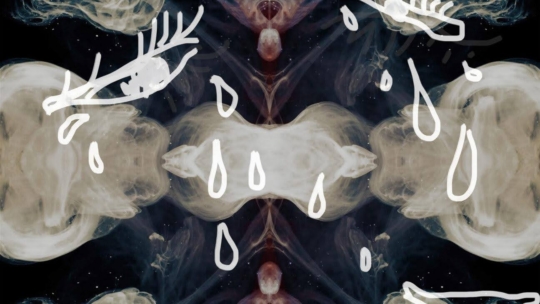
Preludio, Silvia Gatti, 2026
Unmoored, the viewer drifts into Silvia Gatti’s “Preludio” and is immediately enveloped by the soft sound of falling rain, a heartbeat, birdsong. Twisted metal litters the ground in front of the screen, the detritus of a wreck. But the atmosphere is tranquil. A loop of words: ‘peace’ ‘body’ ‘do not fear’, raindrops on glass, an animation of crying eyes, brain scans. And gentle humming, a mother’s lullaby.
Originating from the artist’s near-death experience, “Preludio” unfolds in a series of impressions, a ‘sensory architecture’, responding to a specific challenge—how to consciously perceive the subconscious, even the unconscious? Gatti turns to two seemingly opposing elements to do so: the natural and the digital. The soft soundscape juxtaposes the neon pink of the words on screen; a mother’s singing with brain scans, the visitors’ own body with the lines of wires snaking across the floor. The viewer is painfully aware of the electrical pulse of the brain that makes their perception of the world possible, aware that these impressions, memories, sights and sounds would disappear if the power were unplugged. Gatti constructs a limbo, a pre-waking world that feels close to both childhood and death, a fragile space where, however, one wants to stay.

3 Scenes From a Marriage, Leopold Emmen, 2026
Finally, continuing up the stairs, the visitor ends up in Nanouk Leopold and Daan Emmen’s “3 Scenes from a Marriage”. There’s the immediate sense of having wandered onto the back lot of a film that’s finished shooting. Flimsy papered walls held up by sandbags, a miniature model of a house, a pile of belongings that look like props give the sense of a domestic space in the process of being dissembled. The titular scenes from the marriage are projected onto the walls, the curtains, inside the miniature house. There’s no conflict between the couple—in fact, there’s intimacy, touch, stares as they embrace. Yet there’s a coldness, both to the images and to the room, that transmits the pervasive feeling that something here does not work, has not worked. And the viewer, working their way through the space, becomes certain of it when they notice the details; the faucet is upside down, there are far too many glasses on the table, the video projections are oversized for their supports and spill over into emptiness. Two single mattresses lie awkwardly on top of one another.
“3 Scenes From A Marriage” tackles the limits of our perception of time, choosing to show the sum total of a relationship simultaneously, turning time into a physical space and a unified object. Stories live inside one another, just as the miniature house exists within the larger set, and moments become infinite—a corner of a kitchen implies countless mornings, countless conversations, and the videos keep looping, over and over again.
Perhaps it is because the visitor can’t quite shake the very real danger of “Café Kuba”, or because the rumbling of “Krakatoa” can be heard throughout the halls of Katoenhuis, or perhaps because the scattered metal shrapnel of “Preludio” somehow parallels the domestic wreckage of “3 Scenes”, but there is a motif of explosion in the four installations featured in this year’s Art Directions—a violent release of energy when the world we’ve been trying to hold together finally overwhelms us. Only then do we realize the limits of our ability to impose order and sense onto things. Yet we can perceive that there is more, beyond, and each of the artists in Katoenhuis, in their own way, rethink the cinematic medium in order to show what can’t be seen.