By Rita Ouédraogo
The puppet king dies every year, and every year he returns. In Curaçao’s Karnaval tradition, King Momo, the corpulent figure of collective catharsis, embodies a paradox fundamental to cultural continuity: temporary structures that recur, endings that contain future beginnings. As my tenure at Buro Stedelijk concludes with Kevin Osepa’s exhibition The Belly of Momo, I find myself dwelling within this same paradoxical space: the hollow stomach where spirits rest between celebrations, where mourning and possibility coexist.
Institutional Bellies and Liminal Architectures
Liminality as a threshold state, neither here nor there, where social structures temporarily dissolve, bellies extracting the life-force and recycling less desirables back into our collective earth. Project spaces like Buro Stedelijk function as institutional bellies. Liminal zones within larger cultural bodies where experimental voices gestate, where hierarchies might briefly suspend, where what cannot be spoken elsewhere finds place. These spaces shape themselves to temporariness, and open up onto the magic that is timeless alongside multifaceted temporalities. Yet their impermanence, their ability to be many things at once, and to negate themselves as a protective strategy is precisely what grants them freedom.
When artist Kevin Osepa spoke about Buro as “a space within an institution that dares to imagine the unthinkable,” he identifies what makes temporary structures culturally vital, even questioning the very underpinnings of what ‘culture’ means alongside ‘art’ and ‘aesthetics’. As Rizvana Bradley argues in Anteaesthetics (2023), such spaces operate from the negative underside of form, where artistic practices can interrogate the very structures that claim to contain them. Unlike permanent institutions weighted by legacy and accountability to established narratives, project spaces can hold contradiction. They can be, as David Rudder says of Curaçao, places where “one plus one is eleven” — where ‘colonial mathematics’ no longer apply, where new equations become possible.
This resonates with Black Quantum Futurism’s reimagining of space-time itself, where marginalized communities’ temporal experiences, their ancestral memories and future visions, challenge Western linear chronology and create what Camae Ayewa and Rasheedah Phillips of Black Quantum Futurism, term “community futures.” Such alternative temporal logics found expression at Buro Stedelijk through Manifestation #76 Cosmic Entanglements, where Black Quantum Futurism’s documentation of the Time ZoneProtocols (TZP) Surveyors group examined how colonial time standards lock Black communities out of past and future, confining them to a narrow temporal present. The film’s presentation within the ‘Goddess Change’ speculative fiction reading group, convened by artists Anna Hoetjes and Müge Yılmaz, exemplified how project spaces can host practices that examine new relationships to space-time through specific social, geographical, and cultural frameworks departing from colonial linearity.
Curatorial work, particularly in temporary spaces, cannot but share kinship with ritual practice for we create containers for transformation, orchestrate encounters between objects and publics, mark transitions. Against permanency and its violent histories, kinship offers something else entirely: not just survival, but joy. The exhibition itself is inherently temporary. A gathering that will disappear, a configuration that will dismantle. Yet like Karnaval, its ephemerality does not diminish its power. Rather, the knowledge of its ending intensifies presence.
Throughout my time at Buro Stedelijk, each manifestation has been a small death and rebirth. Artists arrive, spaces transform, publics gather, then disperse. Works are deinstalled, walls repainted, the space holds its breath before the next arrival. This cyclical temporariness has taught me that curatorial practice is less about preservation than about creating conditions for emergence and then, gracefully stepping aside.
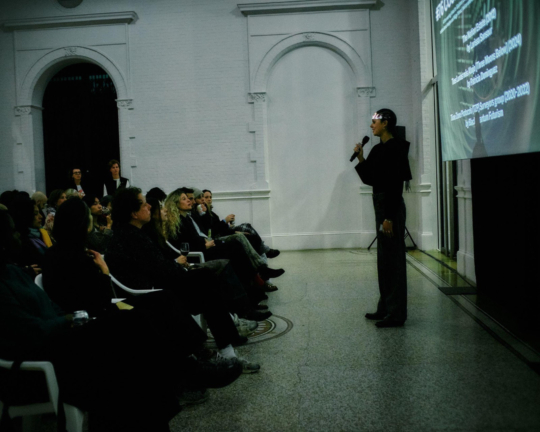
Manifestation: #76 Cosmic Entanglements Buro Stedelijk, Rita Ouédraogo. Photo by Dre.
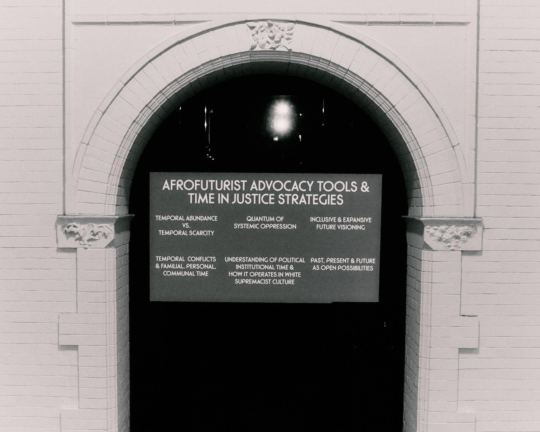
Manifestation: #76 Cosmic Entanglements Buro Stedelijk, still from Black Quantum Futurism that documents the Time Zone Protocols (TZP) Surveyors group. Photo by Dre.
Chanting “Ayo Momo”: Collective Mourning as Creative Act
During the final manifestation, Manifestation #80: the Belly of Momo, with Kevin Osepa, our last exhibition at Buro Stedelijk, we chant ‘Ayo Momo’… We cleanse the space, leaving behind a spirit. This cleansing is not erasure but honoring. An acknowledgment that something lived here, that bodies gathered, that noise was made. In many West African traditions, from which Caribbean cultural practices draw, funerary rituals are not merely about grief but about ensuring proper transition, about feeding ancestors so they might continue to guide the living. Together with artist Kenneth Aidoo, last year during his manifestation at Buro Stedelijk, Manifestation #42: Tell It Like It Is, we organized a funeral for his major mural. A moment to celebrate and mourn an ending.
What does it mean to mourn a project space? To grieve not a person but a possibility structure, a set of relationships, a temporary commons? Our mourning must be collective because what we built was collective. The value of Buro Stedelijk never resided in its physical walls but continues to thrive in what those walls permitted: the nurturing of communities that thrive despite, what Wayne Modest as an important voice and mentor have shown in his work at the RCMC, conversations, kinship between and among people, experiments that larger institutions deemed too risky, platforms for artists whose practices refused easy categorization.
When we cry together, as Osepa suggests, we perform necessary cultural work. We refuse the neoliberal demand that endings be efficiently processed, cleanly transitioned, immediately productive. We insist instead on sitting with loss, honoring what was, acknowledging that some things cannot be replaced, they can only be transformed (temporally).

Manifestation #39:To Be Determined – Buro Stedelijk – (October 2024) Rita Ouédraogo and Kenneth Aidoo in front of Kenneth Aidoo’s mural in Buro Stedelijk’s Central Space. Photo by Anne Lakeman.
The Belly as Generative Void
In Manifestation #80: The Belly of Momo, we frame the belly as a place for temporal possibilities. Where the unspoken and the hidden reside in their purest form. The marginal
spaces, edges, thresholds, hollows, that hold particular power because they exist in the inbetween. The belly is void and full simultaneously, absence pregnant with presence.
As I prepare to leave Buro Stedelijk, I recognize that this ending creates a void, for me in this moment, but filled already by the ongoing kinships that thrive. But voids are not simply empty; they are spaces of potential, sites where new arrangements might crystallize. The question is not what will fill this particular space, that is for others to determine, but what seeds we have planted, what spirits we have fed, what practices we have modeled.
The Belly of Momo offers a framework: the show itself becomes a ritual space where audiences don’t merely observe but enter into relationship with Karnaval’s coded visual and affective language. We ask visitors to be entangled, to allow their perspectives to flip, to surrender certainty. This is what temporary structures can offer. Permission to not know, to dwell in complexity, to trust that meaning emerges through embodied encounter rather than didactic explanation.
What Grows When Certainty Dies
Institutional cycles closing, create opportunities to examine what emerges from creative endings. In Caribbean cosmology, death is not terminus but transition. Ancestors remain active participants in community life; past and present interpenetrate. King Momo dies each year but his spirit persists, informing next year’s incarnation.
Perhaps this is what grows when certainty dies: a more honest relationship with impermanence, a recognition that all our structures are temporary, all our gatherings will disperse. Project spaces like Buro Stedelijk make this truth visible, but it applies equally to larger institutions, to artistic practices, to curatorial careers. We are all King Momos. Temporary vessels for energies larger than ourselves, puppets animated by collective desire for spaces where “one plus one is eleven.”
The gift of mourning institutional endings is that it forces us to ask: What was this for? Who gathered here? What became possible, however briefly? These questions cannot be answered through metrics or reports but only through embodied memory. The warmth of bodies in a small room, the electricity of seeing an artist’s vision fully realized even when it seemed impossible, the quiet satisfaction of knowing we, together, always together, created conditions for encounters that might not have otherwise occurred. We will emphasize the importance of remembering. How we gathered and how we made noise. Noise as refusal of silence, insistence on presence, disruption of dominant frequencies. Throughout its existence, Buro Stedelijk has amplified voices often marginalized within mainstream Dutch cultural institutions, artists navigating colonial legacies, practitioners working at intersections of art and activism, experimental approaches that resist market logic.This noise will not be silenced by physical closure. Like King Momo, like ancestral spirits, like Karnaval itself, the practices we have nurtured will find new containers, new bellies in which to exist. Artists will continue making work, publics will continue seeking spaces of complexity and contradiction, curators will continue creating platforms for the unthinkable.
My own next chapter remains unwritten, but I carry forward lessons learned in this temporary structure: Trust impermanence. Create conditions for emergence then step aside. Honor contradiction. Make space for noise. Recognize that even endings are not final, they are transitions, thresholds, hollows pregnant with future possibility.
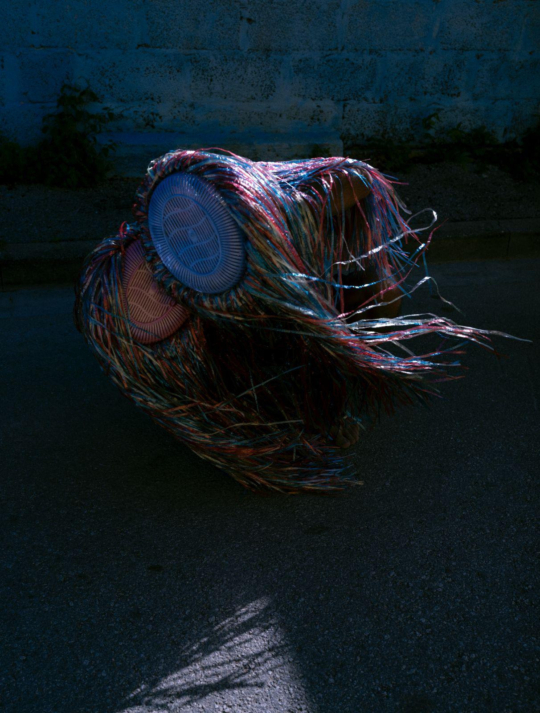
Manifestation #80:The Belly of Momo, Kevin Osepa (2025). Photo by Kevin Osepa.
In Conclusion: Feeding the Spirit
As we prepare for this final exhibition, this last gathering, I think about ritual as technology, ancient wisdom for processing transition. We will cleanse the space not to erase but to honor. We will chant “Ayo Momo” knowing that goodbye is not abandonment but acknowledgment. We will feed the spirits, the ancestors, the artists, the publics, who have animated this space, trusting they will continue to guide us.
The belly of Momo will empty again. The space that housed Buro Stedelijk under my curatorial vision will transform into something else. But the impossibilities we dared to imagine here, the hierarchies we dissolved however briefly, the noise we made together, these persist. They are seeds scattered, waiting for new soil, new bellies in which to grow. In mourning this temporary structure, we honor all temporary structures. We acknowledge that everything we build will eventually dissolve, and we choose to build anyway. We recognize that institutional endings, like carnival cycles, are not failures but completions, necessary deaths that make space for new life.
One plus one does not equal two. In the mathematics of cultural memory, of collective practice, of temporary structures that dare to imagine otherwise, one plus one is eleven. The belly empties, but it will fill again. King Momo dies, and King Momo returns. We say goodbye, and in that goodbye, we plant the seeds of future gatherings yet unimagined.
Ayo Momo. Ayo Buro Stedelijk. Until we gather again, in whatever form, making whatever noise the moment requires.
Rita Ouédraogo is an Amsterdam-based curator, art and culture consultant, researcher, and writer who has built a practice at the intersection of arts and research. Drawing on Black feminist pedagogies and memory work, she interrogates colonialism and its afterlives in Europe and the Caribbean, while challenging institutional power. Her work amplifies narratives of marginalized publics through archives, critical pedagogies, and collaborative methodologies that operate both within exhibition spaces and beyond them.